Summary
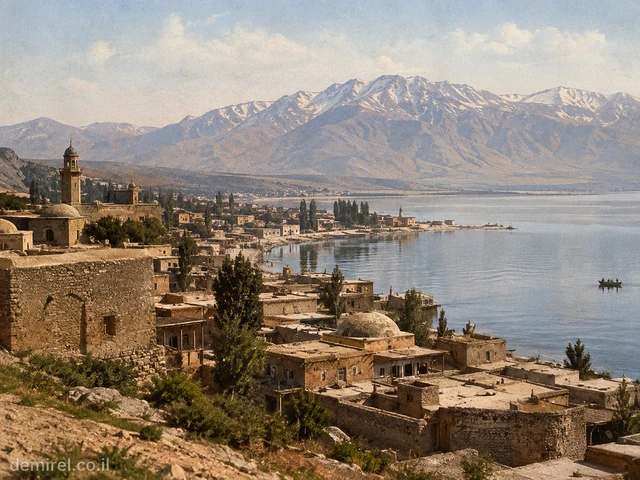
Urmia is one of the major cities of northwestern Iran and the capital of West Azerbaijan Province. Located west of Lake Urmia, the city lies in a historic region that for centuries served as a meeting place of cultures, languages, and religions. Urmia and its surrounding area were home to Muslim, Christian, and Jewish communities, including an established Jewish community that formed part of the complex cultural landscape of northwestern Persia.
The Jewish presence in Urmia is documented at least from the medieval period, while during the nineteenth century the community became increasingly visible in the accounts of Jewish travelers and missionaries. At the beginning of the twentieth century, Urmia was one of the notable Jewish centers of Iran: in 1903/4, approximately 2,200 Jews were recorded in the city.[1] The community was engaged in commerce and various crafts and maintained connections with Jewish communities throughout Iran, Kurdistan, and Anatolia.
The distinctiveness of Urmia’s Jewish community lay not only in its size but also in its linguistic and cultural identity. The Jews of the region belonged to the world of Jewish speakers of modern Neo-Aramaic, particularly the dialect known as Lishán Didán – “our language.” The dialect was part of the family of Jewish Neo-Aramaic varieties spoken across northwestern Iran and eastern Anatolia and served as an important element of communal identity.[2]
The twentieth century brought profound changes to Urmia and its minority communities. World War I and the violence that swept through the region severely affected Christian and Jewish populations, while further waves of migration following the establishment of the State of Israel greatly reduced the local Jewish community. Today, Urmia is a large modern city and an administrative and economic center of West Azerbaijan Province. According to the 2016 Iranian census, the city had 736,224 inhabitants.[3] Alongside its contemporary urban character, traces of its rich multi-religious and multilingual history remain important to the city’s heritage.
Urmia and Its Location in Northwestern Iran
Urmia is located in northwestern Iran, in West Azerbaijan Province, west of Lake Urmia. Its geographical position gave the city particular importance throughout history: it lies within a region connecting the Iranian plateau with Anatolia, Kurdistan, and the basin of Lake Urmia.
Lake Urmia itself is one of the defining geographical features of the region. It is a large salt lake extending between West Azerbaijan and East Azerbaijan provinces. Significant fluctuations in the lake’s size and water level over time have affected the human and economic environment of the surrounding region.[4]
Urmia’s position along regional routes contributed to the development of a culturally diverse environment. Muslims, Jews, Armenians, and Assyrians lived in the area during different periods, and at various times maintained systems of trade, family connections, linguistic exchange, and religious institutions alongside one another.
Urmia as a Multi-Religious and Multilingual Region
One of the most prominent characteristics of historic Urmia was its religious and linguistic diversity. Alongside the Muslim population, the region was home to significant Christian communities, including Assyrians and Armenians, as well as a Jewish community.
During the nineteenth century, Urmia also became an important center of Christian missionary and educational activity. Missions established schools, medical institutions, and printing presses in the city and contributed to the development of a modern written culture in the Aramaic languages spoken in the region. During this period, Urmia became an especially important spiritual and cultural center for Assyrians in Iran.[5]
This multi-community environment is also important for understanding the history of Urmia’s Jews. The Jews of the city did not live in cultural isolation. They belonged to a region in which Persian, Azerbaijani, Kurdish, and several varieties of Aramaic were spoken. Continuous interaction between these languages was reflected in the local Jewish vernacular.
The Early Jewish Community
Jewish tradition in Urmia sometimes associated the origins of Jewish settlement in the region with the Assyrian exile and the exiles of the Kingdom of Israel. This tradition was important to the historical identity of the Jews of the region, but there is no continuous documentary record proving the uninterrupted existence of a Jewish community in Urmia from antiquity to modern times.
Nevertheless, the presence of Jews in western and northwestern Iran is documented in earlier periods. Sources from the Islamic period and the Middle Ages mention Urmia among locations where Jewish communities existed.[6]
In the twelfth century, Urmia was also associated with the figure of David Alroy, a Jewish messianic leader who operated in the region. Later sources describe him as a leader who attracted Jewish supporters in Kurdistan and northwestern Iran. This does not necessarily establish the precise size of the Jewish community in Urmia at the time, but the association demonstrates that the region belonged to the active Jewish world of the medieval period.[7]
The Community in the Nineteenth Century
More detailed information about the Jews of Urmia becomes available during the nineteenth century. In 1828, the Jewish traveler David D’Beth Hillel visited the city and mentioned three synagogues. His account is significant because it indicates the existence of an organized community with its own religious institutions.[8]
The community nevertheless faced difficult conditions. Sources from the period describe discrimination, economic hardship, and episodes of persecution. In 1871, the community was also affected by a famine that struck the region.[9]
During the nineteenth century, Jews in Urmia maintained connections with other Jewish communities in the region, including communities in the Caucasus. These connections formed part of a wider network of trade, migration, and family relationships that crossed the political borders of the period.[10]
Urmia at the Beginning of the Twentieth Century
At the beginning of the twentieth century, Urmia was one of Iran’s important Jewish centers.
According to data from the Alliance Israélite Universelle for 1903/4, approximately 2,200 Jews lived in the city. At the time, Urmia was among the more prominent Jewish communities in Iran.[11]
Another source states that in 1902 approximately 350 Jewish families lived in Urmia, occupying about 200 houses in four separate areas, with a synagogue in each area.[12]
These figures indicate that the community was not a small or temporary settlement, but an established urban population with synagogues, institutions, and its own social and economic networks.
The Jews of Urmia were involved in commerce and various crafts. Textile trading, jewelry, money changing, and peddling were among the occupations associated with the community. Commercial connections linked the Jews of Urmia with other communities in the region, while families sometimes moved between settlements in response to economic opportunities, trade, and marriage.
Lishán Didán – The Language of the Jews of Urmia
One of the most distinctive elements of Urmia’s Jewish heritage is its language.
The Jews of Urmia belonged to a broad network of Jewish communities speaking Neo-Aramaic across northwestern Iran, eastern Anatolia, and the borderlands between Iran and the Ottoman Empire. One of the principal varieties in this region is known as Lishán Didán, meaning “our language.”[13]
The name “Nash Didán” was used to refer to members of the community, while “Lishán Didán” referred to their language. The Urmia variety was a northern Jewish Neo-Aramaic dialect spoken in the Urmia and Salmas regions and in additional settlements in northwestern Iran and neighboring parts of eastern Turkey.
The language was more than a means of communication. It was an important element of family and communal identity and preserved a rich collection of stories, songs, traditions, expressions, and memories of communal life.
Alongside Jewish Neo-Aramaic, Hebrew was used particularly in religious contexts, while Persian, Azerbaijani, and Kurdish were also part of the linguistic environment, depending on place, period, and social setting. Linguistic research shows that Lishán Didán was influenced by the surrounding languages, particularly Iranian and Turkic languages of the region.[14]
Today, Lishán Didán is considered an endangered language. Many of its original speakers left the Urmia region during the twentieth century, while younger generations increasingly shifted to Hebrew and other languages.[15]
World War I and the Rupture of Urmia’s Communities
World War I was a dramatic turning point in the history of Urmia.
The city was located in a sensitive border region between the Russian Empire, the Ottoman Empire, and Iran. Warfare, invasions, violence, and the collapse of regional political order severely affected civilian populations.
The impact was particularly severe on the Assyrian and Armenian communities of the region. Urmia, which had become an important spiritual and cultural center for the Assyrians, became during the war a scene of violence, displacement, and death.[16]
The Jews of the region were also affected by the upheavals of the war. Research on the Jews of the Van–Urmia region shows that war, violence, and displacement between 1914 and 1918 profoundly changed the world of the Jewish Aramaic-speaking communities in the borderlands.[17]
This rupture was not an isolated event. It formed part of a longer process in which new political borders, wars, political changes, and migration transformed the social environment in which Jewish and Christian communities had existed for centuries.
The Decline of the Jewish Community
Following World War I, the circumstances of Urmia’s Jews changed significantly.
Some Jews moved to other locations in the region, while others emigrated from Iran. The establishment of the State of Israel in 1948 accelerated Jewish migration from Iran as a whole and contributed to the shrinking of many local communities.
According to historical sources, most of Urmia’s Jews emigrated to Israel after the establishment of the State of Israel, while others left during later periods, particularly after the Iranian Revolution of 1979.[18]
Within a few decades, a community that had numbered thousands of people at the beginning of the twentieth century had become much smaller.
The disappearance of the organized Jewish population from Urmia did not erase its heritage. Many descendants of Urmia’s Jews continue to preserve in Israel and elsewhere family names, memories, stories, religious traditions, and above all the language of their ancestors – Lishán Didán.
Urmia Today
Today, Urmia is the principal city and capital of West Azerbaijan Province in Iran. The modern city differs greatly from the multi-community city of the late nineteenth and early twentieth centuries, yet the historical heritage of the region remains visible.
According to Iran’s 2016 population census, Urmia had 736,224 inhabitants, reflecting the substantial urban growth the city experienced during the twentieth century.[19]
Urmia is now a regional administrative, commercial, educational, and cultural center. Alongside its predominantly Muslim population, the surrounding region retains an ancient Christian heritage represented by Assyrian and Armenian churches and historical sites.
The nearby lake remains one of the city’s defining geographical symbols, although its environmental condition has changed dramatically in recent decades. The history of Urmia is therefore connected not only to the communities that lived there but also to its surrounding landscape – lake, plains, mountains, and routes that for centuries linked Iran with Anatolia and Kurdistan.
Urmia in Jewish Memory
For the Jews of Urmia and their descendants, the city is more than a geographical location.
It was a center of family life, commerce, synagogues, and language; a place where a Jewish community existed for generations within a multilingual and multi-religious environment. The memory of Urmia has survived not only in historical books but also through family memories, photographs, documents, and language.
Particularly prominent is the heritage of Nash Didán – “our people” – and Lishán Didán, “our language.” The language provides a living testimony to a world connected with Urmia but never limited to the city itself. It linked Jewish communities in Urmia, Salmas, other parts of Iran, and eastern Anatolia.
Research into the language and oral traditions now makes it possible to reconstruct aspects of this world: family life, weddings, holidays, education, commerce, relations with neighboring communities, and memories of war and displacement.[20]
Urmia as Heritage
The history of Urmia is the story of a city and a region, but also of an encounter between different worlds.
For centuries, the city formed part of a region where Iranian, Azerbaijani, Kurdish, Aramaic, Jewish, Armenian, and Assyrian cultures met. The Jewish community was one of the groups that left its mark on this environment, even though today it is scarcely present there as an organized community.
The story of Urmia’s Jews therefore cannot be reduced to the number of Jews living in the city in 1903 or to the number of synagogues that existed there. It also encompasses a distinctive language, intercommunal connections, family traditions, and a cultural heritage that continued after the community itself had largely left the city.
Present-day Urmia is a large modern city. Urmia in historical memory, however, is a city in which Jews, Assyrians, Armenians, and Muslims shared the same geographical space, spoke different languages, and maintained relationships of trade and neighborhood, as well as periods of tension and conflict.
The contrast between these two Urmias – the modern city and the historic city – is central to understanding Urmia’s place in the heritage of the Jews of northwestern Iran.
Footnotes
- Daniel Tsadik, “Judeo-Persian Communities v. Qajar Period (1),” Encyclopaedia Iranica. Source ↩
- Geoffrey Khan, studies on Jewish Neo-Aramaic dialects of northwestern Iran; see also the North-Eastern Neo-Aramaic Database Project, University of Cambridge. Source ↩
- Statistical Center of Iran, 2016 census data; the city population figure is also reproduced in Wikidata. Source ↩
- Eckart Ehlers, “Urmia, Lake,” Encyclopaedia Iranica. Source ↩
- R. Macuch, “Assyrians in Iran i. The Assyrian Community (Āšūrīān) in Iran,” Encyclopaedia Iranica. Source ↩
- Vera Basch Moreen, “Judeo-Persian Communities iv. Medieval to Late 18th Century,” Encyclopaedia Iranica. Source ↩
- “Rizaieh,” Encyclopaedia Judaica. Source ↩
- Ibid., on the account of David D’Beth Hillel in 1828 and his mention of three synagogues in Urmia. ↩
- Ibid.; see also Daniel Tsadik, Encyclopaedia Iranica, on the condition of Jewish communities during the Qajar period. ↩
- “Rizaieh,” Encyclopaedia Judaica, concerning connections between the Jews of Urmia and Jewish communities in the Caucasus. ↩
- Daniel Tsadik, “Judeo-Persian Communities v. Qajar Period (1),” Encyclopaedia Iranica. Source ↩
- “Rizaieh,” Encyclopaedia Judaica. Source ↩
- Hezy Mutzafi and Dan Shapira, study of Jewish Neo-Aramaic texts from Urmia, noting the name Lišán Didán, “our language.” Source ↩
- Jewish Language Project, “Jewish Neo-Aramaic,” together with linguistic studies of the Jewish Neo-Aramaic of Urmia. Source ↩
- North-Eastern Neo-Aramaic Database Project, University of Cambridge. Source ↩
- R. Macuch, “Assyrians in Iran i. The Assyrian Community (Āšūrīān) in Iran,” Encyclopaedia Iranica. Source ↩
- Nesi Altaras, “The Jews of Van-Urmia: Remembering Borderland Migrations (1914–18),” Jewish Social Studies 28.1 (2023), pp. 79–115. Source ↩
- “Rizaieh,” Encyclopaedia Judaica. Source ↩
- Statistical Center of Iran, 2016 census. Source ↩
- North-Eastern Neo-Aramaic Database Project, University of Cambridge. Source ↩
Key Sources for Further Reading
- Daniel Tsadik, “Judeo-Persian Communities v. Qajar Period (1)”, Encyclopaedia Iranica.
- Vera Basch Moreen, “Judeo-Persian Communities iv. Medieval to Late 18th Century”, Encyclopaedia Iranica.
- R. Macuch, “Assyrians in Iran i. The Assyrian Community in Iran”, Encyclopaedia Iranica.
- Nesi Altaras, “The Jews of Van-Urmia: Remembering Borderland Migrations (1914–18)”, Jewish Social Studies.
- North-Eastern Neo-Aramaic Database Project, University of Cambridge.
- Jewish Language Project – Jewish Neo-Aramaic.