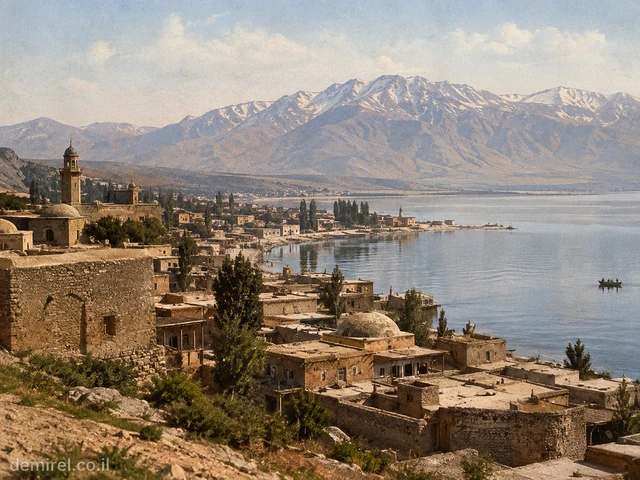
This article was originally published in the newspaper Davar on September 6, 1940.
The journalist Z. Rubashov, who had been hospitalized for several days at Beilinson Hospital, met there Shlomo Ben-Agag’en, born in Orumi (several years before 1890), who told him about the community, its traditions, and much more.
“My neighbor at Beilinson Hospital, bed next to bed, was Shlomo Ben-Agag’en — his name was Aharon Halevi — a man from Urmia in northern Persia, on the border of Azerbaijan and Turkey. The Hebrew community in Urmia was an ancient and remote community, far from the centers of Israel, faithful to Jewish tradition and filled with the troubles of Israel. In my neighbor’s youth, when the new Persian government did not yet exist, and roads and automobiles had not yet appeared in the country, people traveled most roads by carriage and some by train.
“The Jewish community in Urmia was a seven-day journey from the community of Yerevan in the Caucasus in one direction, a twelve-day journey from Susa, the capital, and an eighteen-day journey from Baghdad in the other direction.
“As far as my neighbor could remember, no Ashkenazi Jew had ever come to that city, and a Spanish-speaking Jew would come once a year from Baghdad to sell lulav branches for Sukkot. Once every three years, someone would come from the Land of Israel to collect money for Rabbi Meir Baal HaNes. And as far as I can remember, the name of the Urmia community had never appeared in the Hebrew press, and there was not even an entry for it in the Jewish encyclopedias — as though this ancient Jewish community, held among Muslims and Christians, had never existed at all. It preserved memories from very ancient times, with ancient remnants hidden within the folds of its customs, and in its own way it wove its ancient melody into the distance.
“My neighbor had already learned good Hebrew in the Land of Israel. He was an intelligent and engaging conversationalist, and his memories flowed naturally. Every question led to a long and detailed answer, and I listened with all my ears. I said to myself: I shall preserve something of all that I have learned during these few days. I shall record some of his words, as far as possible, just as they came from the mouth of my companion, and thus mark this distant and forgotten exile — an exile which foreign cultures, distances of days, and the separation of many generations had not been able to extinguish the sparks of loyalty and devotion within it. Experts will come and examine, subtract and add. Those who understand the wisdom of the Diaspora will deepen their knowledge.”
In Exile Among Christians and Muslims
In Urmia there were about five hundred Jewish families. They were scattered throughout the city, which contained many tens of thousands of Muslim and Christian families. Among them were Assyrians, Armenians, and Kurds, while the great majority were devout and zealous Shi’a Muslims.
Among the Jewish families were some who had arrived only recently from nearby Kurdish towns, because during the years preceding the World War, economic conditions had improved in this mountain city near the famous Lake Urmia. Yet most of the Jewish families had lived in the city for generations. My neighbor was born there, as were his father, his grandfather, and his great-grandfather Rabbi Zedekiah.
He did not know when the Jews had first arrived there and had never heard any account of it. But it was said that the Jewish cemetery in the city was five hundred years old.
Most of the Jews were merchants. My neighbor’s father was a tanner, and his uncle was a peddler who traveled among the villages. Once, when my neighbor was still a child, his uncle went out to trade in the villages and never returned. He was found murdered on the road. Later, the villagers came, paid blood money, and made a peace agreement.
Under Persian rule, relations had improved. In the street, it was impossible to distinguish a Jew from a Christian or a Christian from a Muslim. Everyone was permitted to carry weapons, and everyone wore the same type of clothing.
But this had not been the case before the World War. At that time, Muslims persecuted Christians, Christians persecuted Muslims, and both persecuted the Jews.
During the World War, the city changed hands many times — from the Turks to the Russians, and from the Russians to the Kurds — and every such transition was a time of danger for the Jews.
In 1918, when the city remained in Christian hands for nine months, disaster struck. Jewish homes were attacked, people were killed and robbed, and terrible destruction was inflicted. During those days, one hundred and fifty Jews were killed, some of them with terrible cruelty. Among the dead were community leaders, scholars, and wealthy members of the community.
Many then fled the city. In the midst of those bloody days came the news that salvation had come to Zion.
A large convoy of refugees from the community set out for the Land of Israel. About one hundred people were in that group of immigrants from Urmia, and my neighbor, who was then twenty years old, went with them.
Keepers of the Faith
The Jews of Urmia were observant and deeply devoted to their faith and traditions.
There were no great numbers of learned scholars in the city. About two-thirds of the community could neither read nor write. But the third who could read studied the Bible diligently and was careful to observe even the smallest commandment.
Books of the Talmud and the Shulchan Aruch could be found only in the homes of the scholars, while prayer books and Bibles were found among everyone who could read.
Even those who could not read would attend the scholar’s sermons on Saturdays, listening to stories, Midrash, and teachings, and nourishing their spirits with them.
There were four synagogues in the city, and about twenty scholars preached before the congregations. Among the five hundred families of the community there were perhaps ten Jews who did not attend the synagogues. Even these did not attend on weekdays or ordinary Sabbaths, but they came to pray on Rosh Hashanah and Yom Kippur and listened to the scholar’s sermons.
The scholar customarily enriched his sermons with stories and jokes. He preached in the language of the people — a special Aramaic language which they called the language of the Targum of Onkelos. It was also very similar to the language spoken by many of their non-Jewish neighbors. He incorporated many Hebrew verses into his sermons and translated them word for word into the vernacular.
During my neighbor’s youth there was a scholar in Urmia named Rabbi Yeshayahu. His sermons inspired many people, and he drew the hearts of the young closer to Judaism and educated them in Jewish knowledge.
My neighbor had listened to his teachings for many years and learned most of his Torah from him. He never stopped praising the scholar’s knowledge and talent.
This respected scholar was also among those who emigrated with my neighbor in the great convoy from Urmia to the Land of Israel. He later lived in the Bukharian Quarter of Jerusalem, among the immigrants from Azerbaijan.
His reputation even reached Mount Scopus, and university professors attempted to record from him the Aramaic translation of the Torah that was customary among the community.
The scholars were also the cantors and teachers of the children.
When my neighbor was five years old, he began studying the Hebrew alphabet with one scholar. His studies continued for an entire year. He then studied for five years with a second scholar, learning the Pentateuch and Onkelos. Afterwards he went to a third scholar to study the Prophets, continuing until he was fourteen. At that point he himself became an assistant to the teacher.
Girls did not traditionally study. Why should they study? Would they ever become cantors?
Yet the scholar’s sermons reached them as well, and they too listened eagerly to his words.
Only in the final years did a woman in Urmia begin teaching women the Hebrew alphabet and how to read from the prayer book. She had about twenty students in the city, and was therefore called “Rabbi Eve.” She later lived in the Neve Sha’anan neighborhood of Tel Aviv.
The scholars also earned their living by writing amulets and charms. Some amulets were hung around the neck; others were placed in water, which was then drunk or used for bathing.
There were scholars, and even ordinary people, who wrote amulets for Muslims as well.
My companion knew a Jewish man named Shaul Cohen, a peddler who traveled among the villages. He was completely uneducated and did not even know how to write a single letter. Yet the Muslims in the villages believed in him and in the power of his charms.
If a cow went astray at night and its owner feared that a lion might attack it, he would hurry to Rabbi Shaul Cohen to ask for an amulet. The Jewish peddler would draw various signs instead of letters and bless him that he would find his animal safe and sound.
When the cow returned to the yard, the Muslim farmer would kiss the peddler’s hands and feet, pay him generously with produce from his farm, and regard him as a holy man and miracle worker.
The members of the community observed the laws of ritual purity with great strictness, as they had been observed in ancient Israel.
A person who touched a dead body became impure until he washed his entire body in water. If he did not wash and then touched another person, that person too became impure.
If a dead mouse was found in an oven, the oven was destroyed. If a creeping creature fell into food, the food was discarded. If it was valuable, it was sold to a non-Jew; if it was not valuable, it was thrown away.
If a person touched a mouse — “God forbid” — he changed all his clothes, including his shoes, and washed himself in water until he was purified. The person’s clothes could not be touched until they had been washed and purified.
Particular care was also taken regarding matters of marital relations.
Even the least observant person would not eat food prepared by a woman during her period of niddah. During that time, the woman withdrew from social life. No man sat in her chair and no one touched her clothing. She was separated from the rest of the family and remained in her room.
Because the houses were spacious and contained many rooms, there was no difficulty in observing these laws. Even a man with several wives could observe all these regulations fully.
But here in the Land of Israel, where living conditions were crowded and even a worker with a job could not live with his family in more than two rooms, how could all the laws of Israel be observed?
This caused great distress among members of the community, and the women of the community in the Land of Israel wept over it.
Religious celebrations were held with great noise and festivity. When there was a wedding in a Jewish home, the entire street would come alive.
For the Passover Seder, people gathered in the homes of scholars and learned men. A person who could not read the Haggadah — even if he was wealthy — did not conduct the Seder in his own home. Instead, he and his family were invited to the home of someone who could read.
Thus, five or ten families might gather in the home of one learned man and conduct the Seder together.
Everyone observed the Fast of Esther. Some were especially strict — particularly pious women — and fasted for three consecutive days and three nights without interruption.
My neighbor’s sister followed this practice throughout her life.
As it is written in the Book of Esther: “Fast for me, and do not eat or drink for three days, night or day” (Esther 4:16; see also the Beit Yosef, Laws of Purim).
Tu BiShvat was celebrated with particular joy. Its festive character had been preserved from very ancient times.
On that day people ate abundant fruit, the finest produce of the Land, and drank plenty of arak and wine. They gave gifts to the poor and exchanged gifts with one another. Packages of presents were lowered through the roof opening to friends, respected members of the community, and scholars.
They held feasts, drank freely, and enjoyed all good things.
“As people here rejoice on Purim, so we rejoice on Tu BiShvat.”
The “Epicureans”
Within the community there was an ancient dispute, revived in recent generations and causing considerable controversy.
The question was whether the words of the sages, the authors of the Mishnah and Talmud, were sacred like the words of the Torah and the Prophets, or whether they were not sacred and a Jew was free to observe them or not according to his own will.
The number of people who rejected the Oral Law was small. Only a few families held this view, but they defended it firmly and sought to win others to their position.
Members of the community called them Epicureans; they themselves called themselves “People of the Bible.”
At times this dispute existed even between relatives and caused division and continuing unrest.
These “Epicureans” were nevertheless very careful to fulfill what was written in the Torah. They knew the Torah well and studied it extensively.
There was one “Epicurean” who owned a flour shop. When a mouse was found among the sacks of flour, he immediately burned all the sacks and lost his entire fortune.
Yet when the prayer Pitom HaKetoret was reached, the “Epicurean” would leave the synagogue because he refused to recite a prayer originating in the Mishnah.
These “Epicureans” wore the head tefillin literally between the eyes, rather than on the head, based on the verse “and they shall be as frontlets between your eyes,” and placed the hand tefillin literally on the hand, rather than on the arm, according to “and they shall be for a sign upon your hand.”
They welcomed the Sabbath together with all the other Jews and sang Lecha Dodi. But when they reached Bameh Madlikin, they mocked it and left the synagogue.
They observed Passover for seven days rather than eight, and ate leavened food on the eighth day. On Sukkot they sat in the sukkah for seven days rather than eight, and they celebrated Rosh Hashanah for one day rather than two.
Among them was a great preacher, Rabbi Nisan bar Tzadi, who was ninety years old at the time.
He was the leader of the “Epicureans” and would publicly say:
“Why do you abandon Moses our teacher, who was the master of the prophets and with whom God spoke face to face, of whom it is said, ‘There arose not a prophet since in Israel like unto Moses’?
And you follow some Rabbi Ishmael or Rabbi Hananiah, of whom no one knows who they were or what authority they possessed. Perhaps they were liars, perhaps merely ordinary Jews.
How dare you compare Hillel and Rava, who did not stand at Mount Sinai and to whom God did not reveal Himself, with Isaiah the prophet or Ezekiel the prophet?
What has straw to do with wheat?
Leave aside the words of human beings and follow the straight path commanded to us by God through Moses His servant and His holy prophets.”
This elderly preacher too emigrated to the Land of Israel, together with his son and family, and they later lived in the Bukharian Quarter.
Another of the “Epicurean” preachers presented his own analogy:
“The words of the sages are like a marketplace. A person goes out into the street and sees before him a market filled with fruit. Every fruit is beautiful to look at and desirable to the eye.
“If he has money, he buys everything; if he has no money, he buys nothing. He may want one kind and buy another. Today he may buy a great deal, tomorrow only a little.
“That is why it is a marketplace. There is no disrespect in choosing; there is simply choice. Each person chooses according to his taste and ability at that particular time.
“But the words of the Torah and the Prophets are different. They are all clear, all sacred, all spoken from above, and all obligatory. Nothing may be changed in them, not even by a hair’s breadth.”
The scholars opposed the “Epicureans” and declared that they had no share in the World to Come, and the conflict continued.
Some members of the community joined the “Epicureans,” while some of their children returned to traditional observance.
Yet the “Epicureans” did not establish separate synagogues. They prayed together with everyone else.
The community guarded its unity very carefully, through a remarkable instinct for self-preservation, ensuring that even this profound dispute would not destroy its cohesion.
One synagogue continued to contain both the observant and the traditionalists together with those who rejected the Oral Law and challenged established beliefs, despite the deep religious and intellectual differences between them.
This was the situation in Urmia, and it remained so in the Land of Israel.
The Blood Libel
This happened about ten years before the previous World War.
My neighbor was then seven years old. He remembered the commotion that arose in the city, although he later heard the details many times from adults.
There was a Jew in Urmia named Mashiach ben Bato, who was already dead by the time of this account.
He had rented an apartment to a Jewish tenant who had come from another city. Ben-Bato wanted the tenant to leave the apartment before Passover, while the tenant did not want to remain without a home on the eve of the holiday.
An argument broke out between them, followed by blows. Ben-Bato tried to force the tenant out of the house.
The tenant became furious and decided to take revenge on him and on his relatives who had supported him.
He went outside and shouted in the language of the non-Jews that he wanted to convert to Islam, and that the Jewish landlord, Mashiach ben-Bato, had slaughtered a Christian child, taken his blood, and put it into the matzah.
The non-Jews heard this and were delighted. They had long been waiting for such an accusation, and now a Jew himself was accusing another Jew.
A crowd gathered and began attacking Jewish homes and shops.
One Jew was killed, several Jews were wounded, and considerable property was looted.
Compassionate officials from the government arrived and dispersed the attackers. They placed police in the streets, separated Jews and Muslims, drove the attackers away, and restored order.
But the danger had not passed.
Rumors spread that the non-Jews were preparing another attack. Agitators appeared in the mosques and preparations began.
The Jews gathered and decided to persuade the tenant to retract his statement and remove the libel.
Representatives of the community went to speak with him.
They said to him:
“We are brothers. How can you bring disaster upon the entire community with lies that you invented? Will your anger toward one man bring destruction upon an entire community?”
But he refused to listen.
“I am already a Muslim,” he said, “and I know what I must do.
“If this Jew can drive me from my apartment before Passover, I will uproot him and all those who support him, and not a single Jew will remain in the city.”
The members of the community understood the danger and sent for his wife.
They told her:
“Your husband has converted and has spread a vile accusation that could endanger the entire community. We will give you money to support yourself, and we will get rid of your husband. Do not tell him anything.”
Afterwards they sent three prominent members of the community to the tenant.
They brought him one hundred tomans — five tomans being equal to one gold lira. At that time this was a large sum.
They said to him:
“Take this money and retract your statement.”
But he refused to listen and began cursing the Jewish religion.
One of the emissaries was a wealthy man, a learned and highly educated Jew, and a man of great physical strength.
When he heard these blasphemous words, he stood up, removed the belt from his waist, threw it around the man’s neck, gave one end to his companion, pulled the other end himself, and strangled him.
The people of the city were informed that a prominent man had died.
Immediately, the Jews closed their shops and went to the cemetery. They dug a deep grave five cubits outside the cemetery wall and buried him there.
A great danger had been removed from the community.
The Burial of Sheikh Abdulla
There were four synagogues in Urmia. The largest was named after Mullah Moses — Moses the physician — father of the famous doctor and respected Jewish man, Sheikh Abdulla.
Dr. Sheikh Abdulla was highly respected among the city’s physicians. He was loved equally by Jews and Muslims.
Every year he received gifts from the royal court.
During my neighbor’s childhood, people said that one of Sheikh Abdulla’s female relatives had once been taken to the royal palace as a wife, and that this was why the king favored him.
Who knows whether this was true?
In any case, Sheikh Abdulla was a doctor to both Jews and Muslims and was beloved by everyone.
Although the Muslims of the city hated the Jews and often sought excuses to attack them, they greatly loved this doctor, Sheikh Abdulla.
The sheikh always prayed in the synagogue named after his father, Mullah Moses.
Several years before this account, the sheikh died.
The Muslims gathered and said:
“He was like one of us, like a father to us. He healed us and we loved him. We will not allow the Jews to bury him in their cemetery.”
The Jews replied:
“He was a proper Jew, and we are obligated to bring him to a Jewish burial according to Jewish law and tradition.”
A great dispute broke out and there was danger.
They went to the government.
The government said:
“Wait until tomorrow morning, and do not quarrel during the night.”
That night, the government provided guards for the Jews, and the Jews buried him secretly, under cover of darkness.
No one knew anything about it.
Shammai and Avdi
There were many courageous Jews in Urmia, strong men who carried weapons.
Not only in later times, when Jews were permitted to carry weapons, but even earlier, when it was forbidden for a Jew to wear a sword, some secretly carried swords.
But there were two particularly famous men who made a reputation for their courage.
One was named Shammai and the other Avdi.
Both were Turkish soldiers. Both were extremely agile and extraordinarily brave, and all the Muslims were afraid of them.
Shammai was a great friend of the Jews.
Although he did not attend the synagogue to pray and was not strict in his observance, he defended Jews whenever trouble arose and performed many good deeds.
He did not drink wine or arak. Only when he sat among Muslims would he pretend to be drunk, taking great care never actually to become drunk.
Only occasionally on Sabbaths would he drink a little, after which he would beat the Muslims severely.
Once, at the beginning of the World War, the Russians arrived and demanded that the Turkish flag be removed from the city.
The two Jewish heroes, Shammai and Avdi, both Turkish soldiers, said:
“That is impossible. We will not allow the Turkish flag to be removed from this city.”
They fought with the Russians, who could not defeat them.
Eventually the Russians prevailed and captured many Turks.
They also captured many prominent Jews who were subjects of the Ottoman Empire.
Among them was Dr. Sheikh Abdulla. Although he himself was not a Turkish subject, his sons-in-law, who had married his daughters, were Turkish subjects.
Shammai was also taken prisoner.
Later, a rumor spread that the Russians had hanged many of the prisoners and that Shammai had also been hanged in Russia.
The community mourned him deeply, for he had been a courageous man and a great friend of the Jews.
Avdi remained in the city and was imprisoned.
During the Muslim holiday, when groups traditionally gathered to wound themselves with swords and knives, they would go to the prisons and release the prisoners.
(This practice was later prohibited. The mourners were permitted to gather in the mosque and mourn quietly, as Jews, by comparison, mourn on Tisha B’Av. But they were no longer permitted to gather in the streets with swords and knives. In earlier times, however, this had been the custom.)
They also released Avdi.
Avdi was involved in smuggling goods past the customs authorities.
He carried a Mauser pistol, a sword, and six or seven strings of bullets, and he was extremely agile.
Everyone knew him.
Many loved him, but many also hated him, and many informed against him.
Once, on the eve of Tu BiShvat, he went to buy fruit for the holiday.
On his way back from the market, as he reached the entrance to his courtyard with the fruit of the land in his hands, a bullet struck him and he died.
It was never known whether he had been killed by a Christian or by a Muslim.
No one knew.
From Urmia to Jerusalem
Although Urmia was far from the Land of Israel, and no Hebrew newspaper — nor any Jewish newspaper in any language — had ever reached the city, and my neighbor had not even heard the word “Zionism” until the World War, the community was filled with longing for Zion and maintained strong ties with the Land of Israel in general and Jerusalem in particular.
Every Monday and Thursday, when the congregation gathered in the synagogues for prayer, the synagogue treasurer would walk around the entire synagogue during the prayer Uva LeZion Go’el, carrying a charity box.
Every Jew contributed according to his ability for the benefit of the Land of Israel.
Even from the funds collected for the community’s religious institutions, the salaries of the cantors, attendants, and teachers were deducted, while the remainder was dedicated to the Land of Israel.
Once every two or three years, an emissary from Jerusalem would arrive, and the treasurers would hand him the money they had saved for the benefit of the poor of the Four Holy Cities — Jerusalem, Hebron, Safed, and Tiberias.
If the emissary was not satisfied and “made a fuss,” the treasurers would go from house to house among the Jews of the city, collect additional money, and give it to him.
A Torah scholar who came from the Holy Land was treated with great reverence, and every effort was made to fulfill his wishes.
When he preached in the synagogue, the entire community came to hear him; no one was absent.
The emissary also brought books for sale: Bibles, prayer books, and calendars for the general population.
He also brought Talmudic books, Midrash, and books of Jewish law for the scholars and learned men.
If a dispute arose in the synagogue, it was brought before the Torah scholar from Jerusalem, who rendered a decision.
When a wealthy and righteous man could afford it, he would travel to the Land of Israel, visit the Four Holy Cities, pray at the graves of the Patriarchs, at the grave of Rabbi Meir Baal HaNes, at the grave of Rabbi Shimon bar Yochai, and at the grave of Simeon the Just, and pray at the Western Wall in Jerusalem.
He would then return to his city and be honored by the entire community, receiving the title Sheikh.
If he traveled only as far as Baghdad and prayed at the grave of the prophet Ezekiel, he was called a “Half-Sheikh.”
But if he reached the Holy Land and went to Jerusalem, he was greatly honored and called a “Complete Sheikh.”
Such was Dr. Sheikh Abdulla, and so was the wealthy Sheikh Reuven of that time, as were many others.
Fortunate was the man who was privileged to achieve this.
When the massacres broke out in 1918, and Jewish blood was spilled in Urmia like water, and news of redemption arrived and the emigration of the Jews of Urmia began, all eyes turned toward Jerusalem.
About one hundred people emigrated at once.
The roads were extremely dangerous and they had little money, but Jewish communities in the countries through which they traveled supported them and arranged their journeys.
Thus they traveled from Urmia to Susa, from Susa to Baghdad, from Baghdad to Bombay in India, from Bombay to Muscat, from Muscat to Aden, from Aden to Kantara, and from Kantara to Jerusalem.
The journey lasted two years.
Many became ill from the hardships of travel, and some died.
Yet none of them wanted to remain in the cities where they stopped along the way, and even after arriving in the Land of Israel they did not wish to settle anywhere except Jerusalem.
Only representatives of the Zionist Executive, who welcomed them at the time and assisted with their settlement, persuaded them that all the soil of the Land of Israel was sacred, and some of the immigrants agreed to look for work outside the gates of Jerusalem.
Thus the immigrants from Urmia spread throughout the country.
They included members of the Targum community in the Bukharian and Sanhedria neighborhoods of Jerusalem, in Neve Sha’anan in Tel Aviv, in neighborhoods in Safed, and in several settlements in Judea.
In Jerusalem on the Night of Destruction
On the night of Tisha B’Av I went to Jerusalem to visit the members of this remarkable community, to see them in their neighborhood and synagogue, and to examine publicly the details of the testimony I had received from my good neighbor.
I found a new, spacious, and beautiful synagogue, which the people of Urmia had succeeded in building from the proceeds of their labor.
They were all workers, and most were unemployed workers receiving their meager allocation of work through the labor exchange, according to the order of the Histadrut.
In the darkness of the synagogue they sat on the floor by the light of small candles, crowded closely together — the entire community: old and young, children, the faithful keepers of the entire tradition, and also the “People of the Bible,” “who have nothing to do with the Talmud.”
There were members of the First Aliyah who had arrived twenty years earlier, as well as children who had been born in the Land of Israel.
Here too was Rabbi Yeshayahu, respected by the entire community.
Here was also Rabbi Emmanuel, son of the elderly preacher Rabbi Nisan ben Tzadi, “leader of the People of the Bible.”
The father himself was already very old and no longer left his home.
There was also Rabbi Benjamin, from the same group.
Around them sat a large congregation of builders, porters, stonecutters, and workers in every trade.
Before each of them lay a Hebrew scroll of Eichah and the traditional lamentations — a recent Vienna edition, “compiled from Hemdat Yamim according to the Constantinople and Smyrna tradition.”
They looked into the Hebrew books before them and listened to the cantor’s deeply mournful reading, delivered before them in Aramaic.
The cantor himself looked at the Hebrew book of lamentations and read in Aramaic.
He appeared to be reading from a written text, but there was no Aramaic text before him, because none existed.
He was reciting from memory.
This entire translation was an Oral Torah, engraved in the memory of the scholars and literate members of the community and passed from generation to generation, from person to person during childhood, closely attached to the Hebrew text.
Here, separated from the Hebrew text, it was recited by the scholarly cantors verse by verse, following the rhythm and traditional cantillation of the original, with moving warmth.
Every man and woman sitting on the floor understood every single word.
For this Aramaic was their mother tongue, and the Hebrew words — Zion, Jerusalem, the Messiah of God — glittered within it like candles in the darkness of the synagogue.
They finished Eichah and moved on to the poetic lamentations.
These too were in Aramaic, and these too were recited by heart.
The following day came the Midrash Eichah and the stories of the destruction.
They too were in Aramaic, and they too were preserved entirely from memory — a whole and flourishing body of literature carried from land to land and through generations over many hundreds of years, bound together by rhythm, marked by musical cantillation, preserved and sealed like a mighty fortress within the treasures of memory of these men — the workers, builders, and stonecutters sitting before me.
When the prayers ended and the few small candles scattered across the floor were extinguished, the entire congregation remained in darkness.
The scholar raised his voice and announced that on that night 1,871 years had passed since the burning of the Temple, the destruction of the Holy City, and the exile of our people among the nations.
And he burst into tears.
At the sound of this solemn, clear, and terrifying proclamation, the entire congregation broke into bitter, heart-rending weeping, which for several moments seemed to have no end.
“For the burning of our Temple, for the destruction of our Holy City, and for our exile among the nations.”