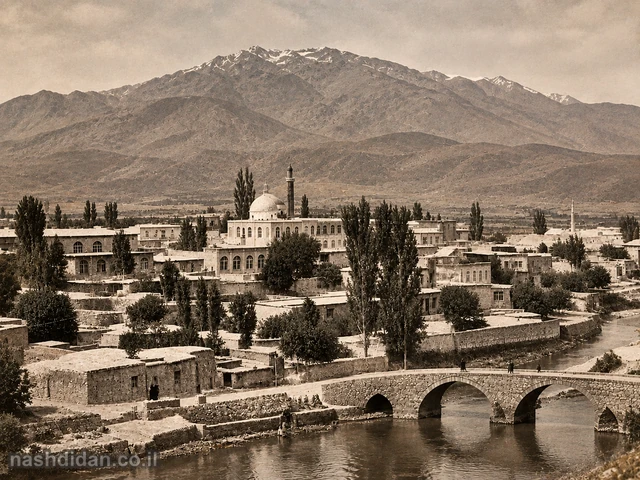
Shino (Shino), known in Persian as Oshnaviyeh (Oshnaviyeh) and in historical sources also as Oshnuya, Ošnu and Ošnava, is a city in northwestern Iran, in West Azerbaijan Province, near the southwestern shore of Lake Urmia. The city lies in a fertile, well-watered valley on the Qader-Chay River, near the historic route that connected the Urmia basin with the Kelashin Pass, Rawanduz and northern Iraq. Its location made it for centuries a meeting point between Iran, Kurdistan and Mesopotamia.
The City and Its Surroundings
Shino is situated in a mountainous agricultural region characterized by available water, pastureland and fertile soil. Muslim geographers of the tenth century described it as a medium-sized town administratively connected to Urmia, in an area rich in orchards, fruit and grapes, as well as pasture for sheep and cattle. The inhabitants of the region were also engaged in trade: agricultural and animal products were transported to cities in the surrounding area, while the city itself served as a center for local crafts and commerce. Encyclopaedia Iranica describes Shino as one of the stations along the historic route from the Urmia basin to the Kelashin Pass and northern Iraq.
Ancient History
The area around Shino has been inhabited since antiquity, and archaeological sites from different periods are found around the city. Southwest of the city, at the Kelashin Pass, stands an Urartian stone stele dating approximately to the eighth century BCE. The Shino region also contains prehistoric sites and sites from the Urartian period, testifying to the importance of the Shino valley in northwestern Iran in ancient times.
Shino has sometimes been identified with Sugunia, a city mentioned in Assyrian sources and associated with the campaigns of Shalmaneser III. However, this identification is not certain, and it is therefore more accurate to present it as a scholarly hypothesis rather than as an established fact. In any case, the archaeological evidence from the region demonstrates human activity and settlement in periods far earlier than the later historical record.
Shino in the Islamic Period and the Middle Ages
During the Middle Ages, Shino was a relatively important town in the region between Lake Urmia and northern Mesopotamia. In the tenth century it was described as a fertile and prosperous town associated with Urmia, while its surroundings were also used by Kurdish tribes who arrived with their herds during the summer. In the following centuries the city experienced political upheavals and warfare. In the early thirteenth century it suffered severe damage during the Mongol invasions, but was later rebuilt. In the fourteenth century, Hamdallah Mustawfi described Shino as a medium-sized town whose population was predominantly Sunni, at the center of a district that included about 120 villages.
Shino also had a significant Christian past. It was an early center of Nestorian Christianity and, after the Mongol invasions, served for a period as the seat of an Assyrian metropolitan. By the nineteenth century, only a small number of Christian families remained in the city, and many members of the community moved to Urmia. Wars and persecutions in the region during the First World War led to the disappearance of the local Christian population.
Shino in Modern Times
In the nineteenth century, Shino was predominantly a Kurdish city. European travelers who visited it described its population and surroundings, as well as the connections between the city and the Kurdish tribes of the region. In 1880, Sheikh Ubaydullah took control of Shino and briefly turned it into a center for his forces during the Kurdish revolt. In the twentieth century, Shino remained a city with a distinctly Kurdish character and was also connected to the region’s political and military events, including the short-lived Republic of Mahabad in 1946.
The Jewish Community of Shino
Alongside the Kurdish population and Christian communities, Shino was also home to a Jewish community. Evidence from the twentieth century places Shino within the wider area of Jewish communities speaking Neo-Aramaic in northwestern Iran, alongside Urmia, Salmas, Solduz and Mahabad. A source documenting the Nash-Didan communities records approximately 80–90 Jewish families in Shino, and scholarly sources include it among the Jewish communities of the region. Additional documentation from the period describes relations between the Jews of Shino and the local Kurdish society, as well as their presence in the city during the 1940s. Additional communal documents, including marriage contracts, are preserved today in the collections of the National Library of Israel.
Shino and the Nash-Didan Heritage
Shino was one of the Jewish communities in the northwestern Iranian region where communities speaking Lishan Didan existed for generations. Its importance lies not only in the history of the local Jewish community, but also in its place within the network of communities linking Urmia, Salmas, Shino, Solduz and the Jewish settlements of the Kurdish region. The history of the city reflects the region’s multi-community character: Kurds, Christians, Jews and other populations lived there during different periods, while the city and the roads around it connected the Urmia basin with Kurdistan and Mesopotamia.
Sources and Links
Encyclopaedia Iranica – OŠNUYA, by Clifford Edmund Bosworth
National Library of Israel – Collection of Ketubbot from the Jewish Diaspora