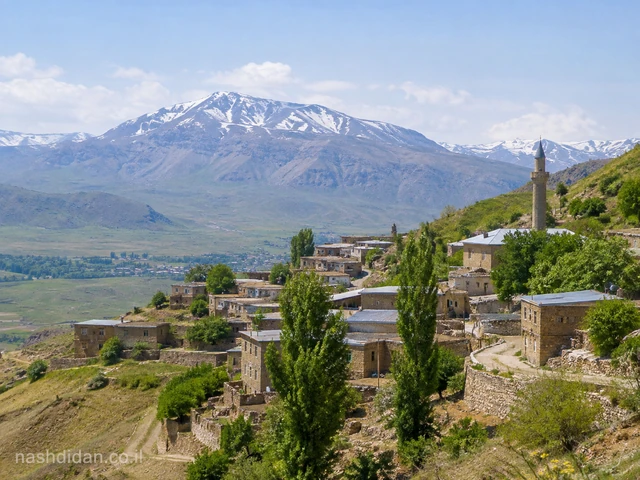
Regional Background and the Establishment of the Community
Başkale is a town in Van Province in eastern Anatolia, near the Iranian border. In the past, the region was home to small Jewish communities alongside a predominantly Muslim-Kurdish population. The Jewish community of Başkale was part of a broader settlement of Aramaic-speaking Kurdish Jews (Nash Didan) in the region, and its history is documented mainly from the nineteenth century onward. According to research and oral testimony, the community was established approximately 150–200 years ago, during the late Ottoman period[1].
Jews appear to have reached Başkale from several neighboring areas: some from northwestern Iran, particularly Urmia and Salmas; some from Iraq, including the Mosul region; and others from Georgia. They settled in the town and formed a close-knit community. They called themselves Nash Didan (“our people”) and spoke a local Jewish Neo-Aramaic dialect known as Lishan Didan (“our language”), a dialect of Northeastern Neo-Aramaic spoken among Jewish communities in Persian Kurdistan and southeastern Turkey[2]. The language was influenced by Kurdish and Turkish and was sometimes incorrectly described as “Judeo-Kurdish.” The fact that the community spoke Aramaic indicates its close cultural relationship with the Jews of Kurdistan and Persia rather than with the Ladino-speaking Jewish communities of western Turkey.
Although early Jewish sources rarely mention Başkale, the community probably developed during the late Ottoman period as a result of regional migration. The Jewish traveler Rabbi David D’Beth Hillel of Safed, who traveled through the Middle East between 1824 and 1832, also visited Başkale and found Jews there[3]. According to his travel account, the community consisted of approximately 20 families and had one synagogue[4]. This is one of the earliest documented indications of a Jewish community in Başkale in the nineteenth century. There is a local oral tradition that the Jews of Başkale had much older roots, perhaps even dating to the Babylonian exile, but no firm evidence has been found to establish such an early origin. Most researchers therefore regard the Başkale community as relatively new, founded by Jewish migrants from neighboring regions during the previous two centuries.
Historical References and Documentation
Information about the Jews of Başkale is scattered among various historical sources, much of it coming from travelers’ accounts and Ottoman population records. As noted above, Rabbi David D’Beth Hillel reported on the Jews of Başkale during his travels in the 1830s[3]. Other nineteenth-century travelers and researchers also mentioned the community as part of the Jewish communities of eastern Kurdistan and eastern Turkey. The Anglican missionary W. A. Wigram, who visited the region toward the end of the Ottoman period, described Başkale in the early twentieth century as a town in which Jews were prominent among the merchants and local property owners[5]. This testimony points to the economic importance of the Jews in the area.
Ottoman archives and censuses provide partial numerical data about the community. Historian Frederic Millingen estimated in 1870 that approximately 2,000 Jews lived in the Hakkari district, corresponding roughly to the Kurdish region of Van and Hakkari and including Başkale[6]. About twenty years later, the French geographer Vital Cuinet reported approximately 1,000 Jews in the Van Sanjak, of whom 500 lived in Van itself[7]. Another Ottoman source from the period, the encyclopedia Kamus-ul Alam by Şemsettin Sami, estimated that approximately 5,000 Jews lived in Van Province between 1889 and 1898, out of a total population of about 430,000. That figure may have been exaggerated.
Toward the end of the Ottoman period, official censuses provided a more precise picture. According to Kemal Karpat’s study based on the 1914 census, there were 836 Jews in Hakkari[8]. A later study identified this number specifically with the Jews of Başkale, while another 273 Jews were recorded in the Güvar district, today’s Yüksekova, in southern Hakkari. Since there were no Jews living elsewhere in Hakkari, the combined figure of roughly 1,100 represents the Jewish communities of Başkale and Yüksekova on the eve of the First World War. These figures suggest that the Jewish community of Başkale numbered several hundred people at its height.
After the collapse of the Ottoman Empire, the Jewish population of eastern Turkey declined rapidly. According to early Republican censuses, 129 Jews lived in Van Province in 1927. The number was similar in 1945, when 132 Jews were recorded, but fell to 76 in 1955 and only 9 in 1960. An unexplained figure of 91 Jews was recorded in 1965[9]. Oral genealogical sources indicate that dozens of Jewish families still lived in Başkale during the 1940s, although many had moved to Van during the 1930s and 1940s. Community members recalled that when the last families left for Istanbul in the early 1940s, they took the old Torah scrolls from Başkale with them and delivered them to the Chief Rabbi in Istanbul.
The historical information about Başkale remains relatively scarce. Researchers point to a lack of sources and to the limited scholarly attention historically given to the Jews of the East[10]. Renewed interest, including interviews with older members of the community living in Israel, has begun to clarify parts of the story. Much of the surviving evidence, however, remains indirect, consisting of statistics, personal memories, and reports by visitors to the region.
Community Institutions and Daily Life
The Jewish community of Başkale was small, but active enough to maintain basic religious and social institutions. The synagogue was the community’s central institution. In fact, it appears to have been the only synagogue in the wider area, to the extent that Jews living in Van were also identified as “Jews of Başkale,” because they conducted their prayers and ceremonies in the Başkale synagogue[11]. Community members recalled traveling there on holidays to pray together, and the name Başkale became almost synonymous with the Jews of the province. According to Shlomo Araban, even in the 1950s Jewish children in Van were careful not to tell outsiders that they had spent their holidays in Başkale, because doing so could reveal that they were Jewish[12].
The synagogue was probably built toward the end of the nineteenth century, perhaps through the initiative of a rabbi who had emigrated from Urmia in Persia. Avigdor Şekerci, the son of the community’s last rabbi, recalled that his father came from Iran and established a synagogue there. This detail is based on testimony rather than an official record. Services were conducted in the synagogue, some of them in the local Jewish Aramaic dialect. Members of the Başkale community recalled that their Torah was accompanied by a translation into the Aramaic language they spoke[13], a feature associated with Jewish communities of Kurdistan.
Other traditional community functions probably existed as well, including a kosher butcher and a small burial society. Avigdor Şekerci was involved in the meat trade, working with a local Muslim butcher to support his family[14]. There is little detailed information about the Jewish cemetery of Başkale, but it is reasonable to assume that a Jewish burial area existed, as was common in other towns of eastern Turkey.
Formal Jewish education was limited. There is no known evidence of an official Jewish school in Başkale, but children learned Hebrew and Aramaic within the community, probably from the rabbi or a local teacher. Some also attended the local state school alongside Muslim children. In the 1940s, for example, only three Jewish children were recorded as attending the elementary school[15]. Jewish life developed quietly within a Kurdish-Muslim environment. Jews adopted local Kurdish and Turkish for everyday communication while preserving their distinctive Aramaic language and religious customs at home and in the community. On Saturdays and holidays, prayers were held in the synagogue, and on major festivals Jews from nearby villages and Van could also come to participate. Despite its small size, the community maintained the major Jewish life-cycle ceremonies, including circumcision, bar mitzvahs, weddings, and funerals.
Rabbis of the community: The names of earlier rabbis of Başkale are largely unknown. The last rabbi of the town belonged to the Şekerci family. His son, Avigdor Şekerci, immigrated to Israel and became an important source of testimony about the community. According to him, his family came from Urmia toward the end of the nineteenth century, which may indicate that Başkale did not previously have a permanent rabbi[2]. The last Rabbi Şekerci served as spiritual leader, kosher butcher, and circumciser, and probably also taught the children. He remained the community’s leading figure until its dispersal. Some young people later traveled to larger cities for religious studies, while most of the younger generation entered the family trades, including commerce, crafts, and small-scale agriculture.
Notable Figures and Connections with Other Communities
The small size of the Başkale community meant that it produced few widely known public figures, but several people are important to its history. The last rabbi, whose first name is not recorded and who is generally remembered simply as “Rabbi Şekerci,” was the spiritual authority under whom the younger generation was educated. His son, Avigdor Şekerci, born in Başkale around 1928, later became one of the principal witnesses to the history of a community that disappeared. He explained that the Jews of Başkale came from several places, including Georgia and neighboring regions. Some were referred to as “Gürcü” or “Gurci,” a name that later became associated with Jews from Başkale in Istanbul[16].
Another important figure was Gershom Şenyuva, from a Yüksekova family with roots in Başkale. Born in 1939, he spent his childhood in Başkale and Yüksekova and was among the last Jews living in the Hakkari region during the 1950s[17]. His family lived under the protection of a Kurdish tribal leader and experienced economic hardship before moving west. Gershom and his family moved to Istanbul in 1952 and immigrated to Israel in 1958[18]. His story represents the generation that left eastern Turkey in the 1950s and illustrates the complex relationships between Jews and their Kurdish neighbors, including economic dependence and patronage.
Shlomo Araban, born in Van in 1951 to a family from Başkale, described how he concealed his visits to Başkale as a child because he feared that revealing them would disclose his Jewish identity[12]. Ephraim Arasli, born in Başkale in 1950, and Eliyahu Ilim, born in Van in 1951 to parents from Başkale, also described the size of the community before its departure—approximately 50–60 families or around 200 people in the late 1940s[9]. Although these people were not nationally prominent figures, their testimonies form an important bridge to the community’s past and have helped contemporary researchers reconstruct its history.
The Jews of Başkale also maintained connections with other Jewish communities in the region. There were marriage and commercial ties with Jews of Urmia and Salmas in Iran and with the Jews of Iraqi Kurdistan, including communities in Amadiya, Zakho, and Mosul. During difficult periods, members of the community sought assistance from larger Jewish communities. After the First World War, for example, impoverished survivors approached Jewish institutions in Istanbul for help. In the 1930s and 1940s, young people seeking a more organized Jewish education could be sent to schools of the Alliance Israélite Universelle in larger cities. Van itself did not develop a separate Jewish community on a significant scale; many of its Jews were originally from Başkale, and in the absence of a synagogue in Van they continued to travel to Başkale on Saturdays and holidays[11]. Başkale therefore functioned as a small religious center for Jews of the surrounding region until the middle of the twentieth century.
The Fate of the Community Over the Years
The history of the Jewish community of Başkale was closely tied to the dramatic changes that transformed eastern Anatolia. Under Ottoman rule, Jews generally enjoyed relative peace and security, although they lived as a protected minority. By the end of the nineteenth century, however, security deteriorated as Ottoman authority weakened. During 1895–1896, large-scale violence against Armenian Christians took place in several eastern cities. Although the Jews of Başkale were not a direct target, they also experienced the growing insecurity. One notable event was the “Başkalе incident” of 1889, when fighting broke out between Armenian rebels and Ottoman forces in the town. The extent of Jewish involvement or casualties is unclear, but the event reflects the increasing instability of the region.
The greatest upheaval came with the First World War (1914–1918), which transformed eastern Anatolia. During the Armenian genocide of 1915, entire Christian populations were killed or deported, and other small communities were also caught in the violence. The Van region became a battlefield between Russian and Ottoman forces. When the Russians withdrew in 1918, Başkale was left exposed to Kurdish and Ottoman forces returning to the area. According to missionary accounts and diplomatic reports from the period, Jews in Başkale faced extreme danger. One contemporary report stated that the inhabitants of Başkale had been “massacred” during the fighting in 1915[19]. Another account describes a group of approximately 40 prominent residents, including wealthy Jews, who were taken captive, forced to carry military equipment through the mountains toward Iran, and then reportedly shot the following day[20]. Other evidence describes killings by Ottoman soldiers and local armed groups during the return to the region[21].
Very few Jews of Başkale appear to have survived the turmoil of the war in the town itself. Some escaped eastward into Iran with the retreating Russian army; there is documentation of a group of Jews from Başkale staying in a refugee camp in Salmas in 1917. Others hid or temporarily blended into Muslim villages in order to survive. By the end of the war, when Turkish national rule was consolidated, almost no continuous Jewish presence remained in Başkale.
Nevertheless, several Jewish families apparently returned or remained in the area after the war. These families concentrated in the provincial city of Van or in Yüksekova to the south, where a small Jewish center developed after the destruction of Başkale. During the 1920s and 1930s, the remnants of the community attempted to rebuild their lives under the new Turkish Republic. Urbanization, economic hardship, and growing Zionist aspirations gradually encouraged migration. The 1934 Thrace pogroms against Jews in western Turkey also strengthened a sense of uncertainty about the future. The Wealth Tax (Varlık Vergisi) imposed in 1943–1944 on wealthy citizens, including Jews, added to the pressure, even though the Jews of Van and Başkale were not among the wealthiest groups in Turkey.
During the 1940s, significant emigration began. Families from Başkale and the surrounding area moved west, some to Istanbul and Izmir and some out of Turkey altogether. After the establishment of the State of Israel in 1948, most Jews of eastern Turkey immigrated there in the early 1950s. Among the last Jews of Hakkari were members of the Şenyuva family from Yüksekova, who left in 1952, as well as other groups who traveled through Iran to Israel in 1955–1956. By 1960, only a few Jews remained in Van and Başkale, and by the beginning of the 1960s the community had effectively ceased to exist[9].
The fate of the community reflects a difficult chapter in the history of the Jews of the late Ottoman and early Republican Middle East. Within several decades, the community experienced violence, displacement, and migration. At the same time, because most of its members eventually immigrated to Israel, the heritage of the Jews of Başkale continued there. Their descendants became part of the Kurdish Jewish community in Israel, established families, and preserved elements of their language and traditions. Lishan Didan and memories of the town remain part of the collective memory of their descendants.
Başkale Today and Its Research Significance
Today there is no known Jewish presence in Başkale or its immediate surroundings. Since the late 1960s, there have been no established Jewish communities in Van Province and eastern Turkey, an area that once contained a diverse mosaic of religious communities[22]. Başkale itself is now predominantly Kurdish and Muslim, and visible remains of its Jewish past are scarce. The synagogue that once stood there was probably demolished or converted to another use. There are also no reliable records identifying a surviving Jewish cemetery in the town. In this respect, Başkale resembles many Jewish communities of Asia Minor that disappeared during the twentieth century.
Over the past decade, scholarly and documentary interest in the Jewish community of Başkale has increased as part of a broader effort to recover the history of “forgotten Jews of the East.” Researchers in Turkey and Israel, including Süleyman Şanlı, have interviewed descendants of Jews from Başkale living in Israel and have collected information from Ottoman administrative records and travelers’ accounts. These efforts have contributed to articles, books, websites, and community initiatives devoted to preserving the heritage. The Nash Didan website, maintained by descendants of Jews from Urmia and Başkale in Israel, documents the history of the community and its language for future generations.
In summary, the Jewish community of Başkale was relatively small and isolated, yet it had a distinctive and compelling history. It developed through regional migration of Aramaic-speaking Jews, became economically active in the late nineteenth century, suffered during the wars and violence of the twentieth century, and eventually dispersed into the new State of Israel. Its story sheds light on a less familiar part of the Jewish diaspora: the communities of the Turkish-Kurdish mountains that lived alongside their neighbors while preserving distinctive religious and linguistic traditions. New research and the testimonies of the last generation to remember these communities make it possible to document the heritage of the Jews of Başkale before it disappears from historical memory.
Sources
A substantial part of this article draws on the research of Süleyman Şanlı, including his work on Jews of Turkey: Migration, Culture and Memory (2019), as well as material published on the Nash Didan website. Additional sources include the Ottoman census of 1914, works by Vital Cuinet and Şemsettin Sami, travelers’ accounts, and oral testimonies of members of the community in Israel.
- Jews of Başkale and Van — Nash Didan
- Jews of Hakkari (Gever) — Nash Didan
- DergiPark — historical research on eastern Turkey
- Presses universitaires de Rennes — L’enseignement français en Méditerranée
- Zaptieh: Quotes & Texts
- Culture, Migration and Memory of Eastern Jews — PDF
- Historical document concerning events in Başkale — INTROD.DOC