Our Language — Audio & Video
As part of the “Lashon HaBayit” (“The Language of the Home”) project, which documents and preserves the languages and cultures of Jewish communities under the auspices of the Academy of the Hebrew Language, Isaac Dehfor was recorded speaking in Lishan Didan, the Jewish dialect of Salmas, about health and folk medicine.
The conversation took place in 2020, with Sara Rosenblat participating and Yael Baruch documenting it. The video, titled “Natural Medicine,” is dedicated to the memory of Eliyahu, son of Rachel and Avraham Dehfor.
Isaac Dehfor recounts folk customs, home remedies, and stories about family members and other people known for treating illnesses and medical troubles. His accounts preserve knowledge and beliefs that were part of community life and passed down through generations.
The original recording is presented here alongside the Hebrew translation by Gabriel Bagar, editor of the Lishan Didan dictionary on the Nash Didan website. This English version follows the Hebrew translation and preserves the sequence of stories and the details reported by the speaker.
The video: Natural Medicine
Recording source: “Natural Medicine” — the Lashon HaBayit project.
Isaac Dehfor’s account
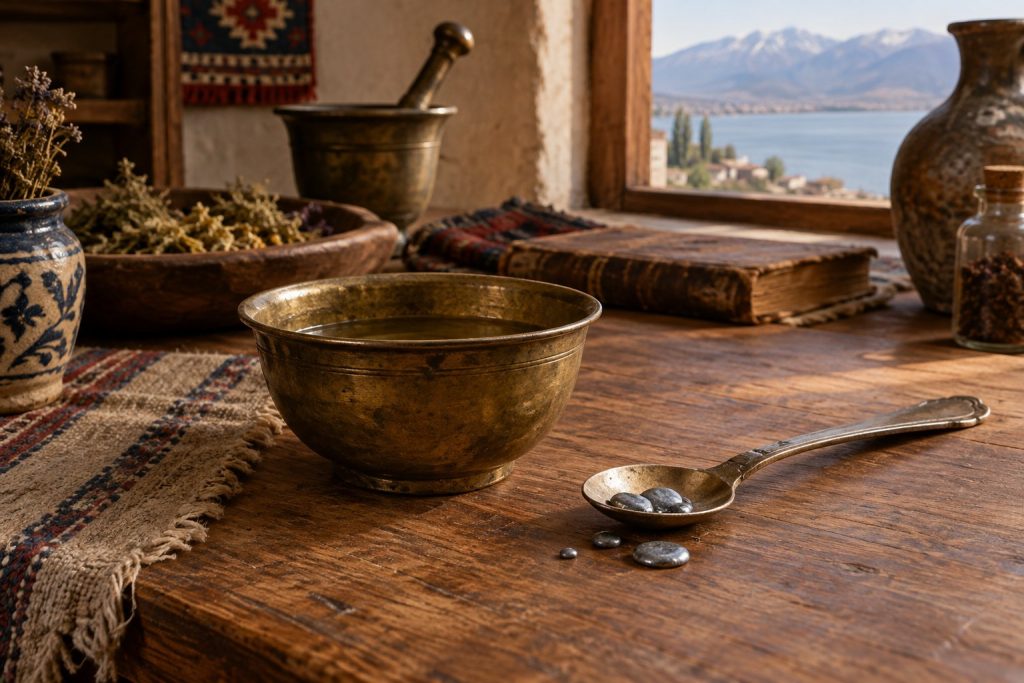
Melting lead to ward off the evil eye
Isaac Dehfor describes the custom of melting lead in order to ward off the evil eye. According to him, not everyone knew how to perform the ritual: in addition to melting the lead, it required special whispered formulas and prayers.
In general, women were the ones who prepared the various traditional home remedies.
The grandfather who helped a child who could not breathe
Dehfor explains that his grandfather was knowledgeable in many areas and was highly respected by the people around him.
One day, a woman came to his grandfather and complained that her son was unwell. The child seemed to be choking, as though he could not get enough air, and the medicines he had received from doctors had not helped.
His grandfather told her, “Don’t worry. I’ll treat him, and he’ll be all right.”
He went to the woman’s home, placed his hands on the child, opened his eyes, and pressed on both sides of the child’s throat. The child began to breathe.
Home remedies and the treatment of a boil
Dehfor next recalls that his wife’s mother was also skilled in various practices, including preparing different kinds of traditional home remedies.
In those days, in rural areas, women were the leading figures in this kind of healing.
One remedy was used for a boil or abscess. Flour was mixed with water to make dough; oil was worked into the dough, which was then placed on the boil.
According to the account, the dough drew out the pus, the boil burst, and the wound dried up.
The grandmother, the doctor from Germany, and Mary the healer
Dehfor tells how his grandmother became unwell. Her back seized up, and she could no longer move. He describes her bones as having become “like cotton wool.”
The family had money and could afford to call a doctor from Germany. The doctor came, examined the grandmother, and said, “I’m sorry, there is nothing to be done. She will remain like this for the rest of her life.”
The people present wondered what would happen next. Then someone said that a Sephardic woman named Mary lived somewhere in the area and was an expert in cases like this.
They brought Mary to the house. She told them, “Within three weeks, I will make her well.”
The family did not fully believe her and even suspected that she was a charlatan. But they felt they had no other option and agreed to let her treat the patient.
A rug was spread on the floor and the grandmother was laid on it. Mary began massaging her body and, according to Dehfor’s account, the woman recovered.
A relative who suffered from postpartum depression
In another story, Dehfor speaks of a female relative whom he calls “ḥalti” in Lishan Didan. He first describes her as his mother’s sister, but later says that she was his father’s sister.1
The woman’s daughter suffered from depression after giving birth. The family had enough money to consult various doctors and buy medicines, but nothing helped.
A non-Jewish man in the area was known for driving spirits out of people. The family turned to him and, according to Dehfor, he succeeded in restoring the young woman to her senses.
Translator’s note
1 The Hebrew translation identifies the Lishan Didan word as “ḥalti,” meaning the mother’s brother. However, the speaker first describes the relative as his mother’s sister and later as his father’s sister. The discrepancy is preserved here as it appears in the translated account; the exact family relationship cannot be determined from it.
About the recording and its cultural significance
Isaac Dehfor’s stories document folk traditions, healing practices, and memories of family and community life. They preserve, among other things, the ritual of melting lead to ward off the evil eye, the use of traditional home remedies, the role of women in healing, and beliefs in folk healers who could help when conventional medicine seemed ineffective.
The recording is also linguistically important. Dehfor speaks in Lishan Didan, the Jewish dialect of Salmas, preserving the language as it was spoken by members of the community. Together with the original video, this translation makes the testimony and the cultural world it evokes accessible to readers who do not speak the language.
Video source: “Lashon HaBayit” project, documenting and preserving Jewish languages and cultures, under the auspices of the Academy of the Hebrew Language.
Speaker: Isaac Dehfor.
Conversation participant: Sara Rosenblat.
Documentation: Yael Baruch, 2020.
Hebrew translation: Gabriel Bagar, editor of the Lishan Didan dictionary on the Nash Didan website. This English version follows that Hebrew translation.
These stories document historical beliefs and customs; they are not medical advice or recommendations for treatment.