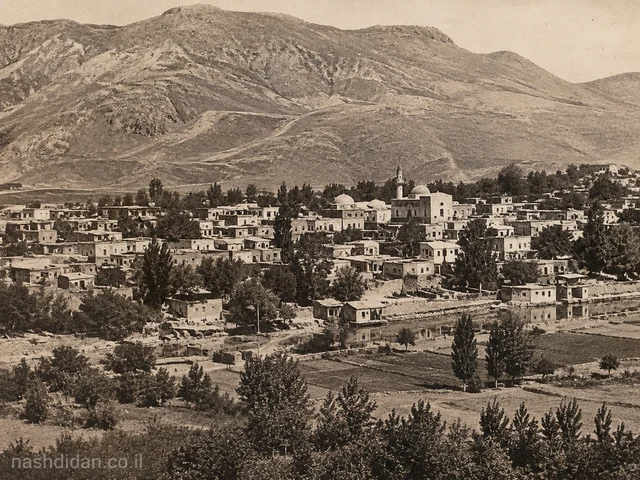
Salmas is the name of a historic region and settlement area in northwestern Iran, in present-day West Azerbaijan, near Lake Urmia and the border with Turkey. For centuries, the region was a meeting place between Persia, Azerbaijan, Kurdistan, and Anatolia, and Muslim, Jewish, Armenian, Assyrian, and Chaldean communities lived there side by side. In the history of the Nash Didan, Salmas is one of the central places: together with Urmia and Bashkale, it formed part of the area in which an Aramaic-speaking Jewish population lived, maintaining family, commercial, marital, and migratory ties with neighboring communities.
Salmas, Kohneh Shahr, and Dilman — Three Names That Must Not Be Confused
One of the main sources of confusion in describing the history of Salmas is that the name “Salmas” was used over the centuries both for the region and district and, at times, for a particular city. Therefore, when a historical source mentions Salmas, it does not necessarily mean the modern city that bears that name today.
The historic city referred to in many sources is Kohneh Shahr (Kohneh Shahr, “the Old City”), also called Shehir, simply “the city.” Kohneh Shahr was an ancient settlement on the Salmas plain, southwest of Dilman. An 1833 account describes “Old Salmas” and notes that the locals simply called it “Shehir,” meaning the city. According to the Nash Didan site, the Jewish quarter was located in this old part of the settlement, known as Kohneh Shahr. The 1833 account of the Jews of Salmas
In contrast, Dilman (Dilman, Dilmaqan, or Dilmaghan) became the important urban and administrative center of the Salmas district in more recent centuries. Kohneh Shahr and Dilman were therefore distinct settlements, even though both belonged to the wider Salmas region and their names are sometimes mixed in historical sources. After the great earthquake of 1930, Dilman was destroyed, and the new city built west of its ruins was first called Shahpur and, after the Iranian Revolution, was renamed Salmas. Thus, modern Salmas is largely the urban successor of Dilman, while historic Kohneh Shahr is associated with Tazeh Shahr (“the New City”), built in its place after the earthquake.
This distinction is especially important when discussing the Jews of Salmas. The Jewish community that lived in “Kohneh Shahr” is not necessarily geographically identical with the community that lived in Dilman, although both communities belonged to the same regional environment and maintained connections. Likewise, when later documents speak of “Salmas,” it is important to determine whether they mean the district, the wider region, the old city, or the newer urban center.
The Salmas Plain and the Old City
The Salmas plain is a relatively fertile area, irrigated by streams and channels and surrounded by productive agricultural land. Western travelers who visited the region in the nineteenth century were impressed by the fertile plain, gardens, and orchards. An 1833 account describes a flat and fertile area surrounded by villages and fruit trees, within which Old Salmas was situated. The same account mentions ancient architectural remains, including brick towers bearing Arabic inscriptions.
Kohneh Shahr was a settlement with an ancient past. Among the buildings destroyed in the 1930 earthquake were the great mosque and the brick tower known as the Miri Khatun Tower, a structure dating from the Ilkhanid period. The seismological study by J. S. Tchalenko and Manuel Berberian identified the area between Kohneh Shahr, Payajuk, and Zaviyehjuk as an area of particularly severe destruction.
An Ancient Jewish Community in the Salmas Region
Nash Didan tradition traces the beginnings of Jewish settlement in the region to very ancient times, particularly to the Assyrian exile and the exiles of the Kingdom of Israel. This tradition is an important part of the community’s identity, but it should be distinguished from a continuous historical record. We do not possess an unbroken series of sources proving the existence of a Jewish community in Salmas throughout the entire period from antiquity to modern times. The detailed and more secure documentation becomes especially rich from the nineteenth century onward.
Salmas was part of the wider Jewish environment of northwestern Iran and eastern Anatolia. Alongside Urmia, Bashkale, Shino, Narda, Sablagh, and other communities, it formed one link in a network of Jewish communities in which local Jewish traditions and Jewish Aramaic were maintained.
The Jews of Salmas in 1833
One of the most interesting accounts of the community is that of the missionaries Eli Smith and H. G. O. Dwight, published in 1833 as part of their research in Armenia. The text should be read critically because the authors were missionaries and their descriptions of Persian Jews sometimes included generalizations and prejudices. Nevertheless, their local description of Salmas and its synagogue is an important historical source.
The authors describe Old Salmas and note that its synagogue was clean and well maintained in comparison with the local churches they visited, and that the Jews were relatively well dressed. They also describe beautiful Torah scrolls that they attempted to acquire. They estimated that approximately 30–35 Jewish families lived in Salmas. This figure is lower than numbers appearing in later sources and should therefore be treated as the visitors’ estimate rather than as a census.
Of particular importance is the note preserved on the Nash Didan site following publication of the account: according to local knowledge and tradition, the Jewish quarter was in the old part of the settlement — Kohneh Shahr. This gives the distinction between historic Salmas and the modern city particular importance for the history of the Jewish community.
Persecution and the Condition of the Community in the Nineteenth Century
The Jewish community of Salmas lived under restrictions and in conditions of insecurity. A communal document from 1869, published in the newspaper Ha-Maggid, presents a very difficult picture of Jewish life in the region. The letter, written on behalf of members of the Salmas community who were then in Tbilisi, describes special taxes, confiscation of property, forged documents, violence on the roads, men fleeing the area, hardship among the families left behind, and even attempts at forced conversion. The details should not be treated as a statistical or fully objective description of the entire community, but the letter is a direct testimony to the distress and insecurity experienced by some members of the community in the middle of the nineteenth century.
The 1869 letter contains the names of dozens of members of the community, including Daniel son of Mashiah, Ezra son of Jacob, Jacob son of Isaac, Mordecai son of Gabriel, Nissim son of Michael, Siman Tov son of Jonah the Cohen, Joshua son of Eleazar the Cohen, Isaac son of Rahamim the Cohen, and others. The list of signatories is important evidence that Salmas had an organized communal framework, with leadership, a rabbi or religious authority, and representatives able to appeal to Jewish bodies outside the region for assistance.
The appeal of 1869 was addressed to the traveler Joseph Judah Chorny, who was working on behalf of the Alliance Israélite Universelle. Members of the community asked him to convey their distress to the Alliance in Paris and help them obtain assistance and protection. The existence of such an organized appeal reflects the growing connections between relatively isolated Jewish communities in northwestern Iran and Jewish institutions in the West.
Connections Between Salmas, Urmia, and Bashkale
Salmas was not an isolated community. It was part of a regional network of Jewish communities in which families, merchants, religious figures, and craftsmen maintained connections. Urmia was the larger urban and communal center of the region, while Salmas lay to its north; across the Ottoman border were Jewish communities in Bashkale and Gabur. Until the First World War, a cross-border Jewish sphere operated between Lake Van and Lake Urmia, with family, commercial, and religious connections crossing political boundaries.
A family testimony published on the Nash Didan site, in a story about immigration from Urmia to Jerusalem, lists Jewish settlements in the region and estimates their numbers of families. According to this testimony, Salmas had about 150 families, Dilman about 50, Urmia 250–300, Bashkale 150–170, Gabur 40–50, Narda 150, and Shino 80–90. These are personal testimony rather than official census figures, but they illustrate the relative size of Salmas within the Nash Didan network of communities.
Lishan Didan — The Language of the Jews of Salmas
The Jewish heritage of Salmas cannot be reduced to population figures or synagogues. One of the community’s most distinctive characteristics was its use of the Jewish Aramaic language known as Lishan Didan — “our language” or “our tongue.” The Nash Didan used this Aramaic within the family and in everyday life, alongside the surrounding languages, including Azeri, Persian, and Kurdish.
Local differences among the dialects of Lishan Didan were significant. The site includes an article by Gabriel Bager on pronunciation differences between the Urmia and Salmas communities and those of Naghadeh and Sablagh. Bager discusses, among other things, differences in final vowels, stress placement, and the pronunciation of letters. His work emphasizes that the language was a living system of local dialects rather than a completely uniform language across all communities.
These differences are important for understanding the identity of the Jews of Salmas. They show that the Nash Didan were not linguistically uniform, but rather a network of closely related communities in which local dialects developed.
Salmas During the First World War
The First World War was a devastating turning point for the Jews of Salmas and the surrounding communities. The region between northwestern Iran and eastern Anatolia became a theater of war, invasion, military withdrawal, intercommunal violence, and population displacement. The cross-border connections that had existed for generations were severely disrupted.
One of the best-known events in the history of the region took place in 1918 at Kohneh Shahr, when the Assyrian leader Mar Shimun was assassinated during a meeting with Simko, a Kurdish leader. A family article preserved on the site describes the assassination and the violent developments that followed. According to the testimony presented there, the assassination of Mar Shimun became a trigger for further killings and warfare, and the Jewish community was caught up in the violence. The article relates that Jews from Kohneh Shahr and Salmas were forced to flee to refugee camps and that, after the Ottoman withdrawal, some began returning to their villages. The Mar Shimun Family, Patriarch of the Assyrian Church
The distinction between historical research and family memory is important here. The testimony preserved on the site records how these events were remembered by Jews of Salmas, particularly the sense that the Jewish community had become trapped between armed groups over which it had no control.
Another testimony, by Ovadia Yedidia, describing his escape from the region and his family’s long journey toward the Land of Israel, recounts Jews gathering in the synagogue in Salmas during the persecutions and the burning of the synagogue. According to the testimony, some Jews were saved through the actions of members of the community and local leaders. This is a personal source of memory and should therefore be presented as testimony rather than as a substitute for comprehensive archival research.
The Destruction of 1930 and the Transformation of Salmas
On May 6, 1930, a devastating earthquake struck the Salmas plain. Kohneh Shahr lay within the area of greatest destruction and was destroyed. The study by Tchalenko and Berberian estimates that the settlement had about 2,290 inhabitants before the earthquake and that approximately 370 were killed, while noting uncertainty in the casualty figures. Dilman, the region’s major urban center, was also almost completely destroyed.
After the disaster, the map of the region changed. Old Kohneh Shahr was replaced by Tazeh Shahr, “the New City,” while Dilman was not rebuilt exactly on its original site. West of the ruins of Dilman, Shahpur was established and later took the name Salmas. This is one of the main reasons why modern “Salmas” and the “Salmas” mentioned in nineteenth-century sources do not necessarily refer to exactly the same physical location.
The Jewish Community in the Twentieth Century
Evidence from the twentieth century indicates that a Jewish community continued to exist in Salmas, although its size changed at different times. Ovadia Yedidia’s immigration account gives an estimate of about 150 Jewish families in Salmas as part of a list of regional communities, whereas earlier sources give much smaller figures. The differences reflect, among other things, different periods, the distinction between a city and a district, and the difference between family estimates and household counts.
The Jews of Salmas engaged in commerce and various occupations, following broader patterns found among Jews of the region. Restrictions placed on Jews and difficulties in owning agricultural land contributed to reliance on trade, peddling, crafts, and activity between towns. The 1833 account already notes that the Jews of Salmas were not farmers, while the 1869 letter emphasizes the difficulty of making a living from the land and the need for men to leave the area in search of a livelihood.
Commercial links between Salmas, Urmia, and the other settlements were an integral part of communal life. Jews traveled between communities for trade, marriage, study, and family connections. In this sense, the “Salmas community” was not simply a population living within the boundaries of one city, but part of a wider social system.
Salmas Within the Nash Didan World
The identity of the Jews of Salmas fits closely with the concept of Nash Didan — “our people.” This was a name used by members of the community to describe themselves and their social and linguistic world. Urmia, Salmas, and Bashkale were among the major centers of this world, alongside many other settlements.
For this reason, the Jewish history of Salmas cannot be understood separately from the Jews of Urmia or the Jewish communities of eastern Turkey. Family and commercial ties, linguistic closeness, and movement between settlements created a shared cultural sphere.
Salmas, Dilman, and Kohneh Shahr in Communal Memory
In communal memory, the names Salmas, Kohneh Shahr, and Dilman continue sometimes to appear interchangeably. Later generations used the name Salmas to describe the wider area, while people familiar with the local geography distinguished between the old city, Dilman, and the other settlements. The Nash Didan site has likewise noted that modern Salmas was established on the ruins of Dilman, which lay somewhat east of the old city of Salmas.
Therefore, when we say “the Jews of Salmas,” the term may refer to the community that lived in historic Kohneh Shahr, the community in the Dilman–Salmas area, or a broader group of Jews who lived in the Salmas district. The most accurate approach is, whenever possible, to identify the period and the particular settlement.
From Salmas to Israel
Migration from Salmas and the surrounding communities did not begin only after the establishment of the State of Israel. Already in the nineteenth and early twentieth centuries, Jews left the region because of persecution, economic hardship, and the search for security and livelihood. The First World War and the persecutions of 1918 accelerated displacement, and some refugees moved to Urmia, Baghdad, the Caucasus, and other places.
After the establishment of the State of Israel in 1948, the connection to the Land of Israel strengthened and immigration increased. Members of the Nash Didan communities of Salmas, Urmia, Bashkale, and nearby settlements arrived in Israel in different waves and established families and communities. Some of the linguistic and religious heritage was preserved in synagogues and families, while other knowledge was passed on through stories, photographs, documents, inscriptions, books, and recordings.
Migration to Israel did not erase the memory of Salmas. For many descendants of the community, the place names — Salmas, Kohneh Shahr, Dilman, Urmia, and Bashkale — are keys to understanding family roots and reconstructing connections between families that once lived within the same regional world.
The Historical Memory of Salmas on the Site
The Nash Didan site preserves several sources that allow a broader picture of the community to be reconstructed. The 1833 account describes the synagogue and estimates the number of families; the 1869 document presents the community’s distress and the names of many of its members; articles about Urmia and Bashkale show the links between communities; and testimonies concerning the First World War preserve memories of displacement and violence.
The linguistic material is also important for understanding Salmas. Gabriel Bager’s article on pronunciation differences between Urmia and Salmas and Naghadeh and Sablagh shows that the local dialect was an integral part of community identity.
Alongside written sources, it is important to preserve family memories: the names of ancestors, immigration stories, photographs, documents, inscriptions, synagogue names, places of residence, and stories about commerce and family connections. Sometimes such small details are precisely what make it possible to connect a community that existed more than a century ago with families living today in Israel.
Conclusion
Salmas was much more than the name of a city. It was an entire historical region in which different settlements existed — above all Kohneh Shahr and Dilman — and in which one of the important communities of the Nash Didan Jews developed. Kohneh Shahr, “the Old City,” was the historic city associated with ancient Salmas; Dilman developed as the urban and administrative center of the district; and after the earthquake of 1930 the city of Shahpur was established and later renamed Salmas, while Kohneh Shahr was replaced by Tazeh Shahr.
The Jewish community of Salmas is clearly documented at least from the nineteenth century. These sources reveal a synagogue, Torah scrolls, communal leadership, families, commerce, connections with Urmia and other communities, as well as hardship and persecution. In the twentieth century the community experienced the upheavals of the First World War, the events of 1918, and the earthquake of 1930, and later gradually diminished as most of its members emigrated.
Yet the community did not disappear. It continued in the memory, language, families, and traditions of the Nash Didan in Israel and around the world. Salmas, Kohneh Shahr, and Dilman are not merely names on a map: they are part of the memory map of a distinctive Jewish-Aramaic community that existed for generations in the region between Urmia, Kurdistan, and Anatolia.
Sources and Further Reading
- Kohneh Shahr – The Diary of Signor Demirel
- Historical Map of Salmas – Kohneh Shahr, Dilman, and the Surrounding Settlements
- The Jews of Salmas from an 1833 Book
- The Jews of Salmas in an 1834 Book
- The Jews of Persia Minor – Salmas, 1869
- Pronunciation Differences in Lishan Didan / Gabriel Bager
- The Mar Shimun Family, Patriarch of the Assyrian Church
- From Urmia to Jerusalem – The Testimony of Ovadia Yedidia
- Nash Didan – Background and Community Heritage
Academic Sources
J. S. Tchalenko and M. Berberian, “The Salmas (Iran) Earthquake of May 6th, 1930”, Annals of Geophysics, 27 (1974), 151–212.
Nesi Altaras, “The Jews of Van-Urmia: Remembering Borderland Migrations (1914–18)”, Jewish Social Studies, 28, no. 1 (2023), 79–115.
Geoffrey Khan, The Jewish Neo-Aramaic Dialect of Urmi, Gorgias Press.
Houman M. Sarshar, “Judeo-Persian Communities of Iran”, Encyclopaedia Iranica.