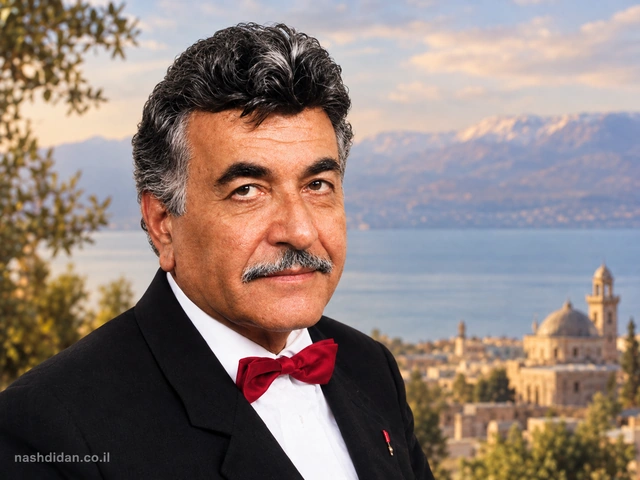
This article brings together, in one accessible place, the memories of Nissan Aviv about life in the Jewish community of Urmi (Urmia). The material is based on a series of recordings and interviews collected as part of the NENA – North Eastern Neo-Aramaic project at the University of Cambridge. In them, Nissan Aviv describes community life, family, commerce, schools, festivals, customs, relations with neighbors, and the difficult events that affected the region. The Cambridge database contains fourteen audio entries documenting Urmi, all spoken by Nissan Aviv and transcribed by Geoffrey Khan.
A Personal Memory That Became Historical Testimony
The importance of this testimony lies not only in the major events it recalls, but also in the small details: what people ate during winter, how matzah was prepared for Passover, what weddings were like, which occupations Jews practiced, how children were taught, what place the Jewish quarter held in daily life, how relationships with Christians developed, and what happened when local authorities tried to force Jewish merchants to open their shops on Saturday.
The material presented here is treated as the personal memory and testimony of Nissan Aviv. It should not be understood as a description of every Jew in Urmi in every period, but as the testimony of a man who grew up within the community and remembered its way of life from personal experience.
Urmi as Aviv Remembered It from Childhood
In Aviv’s testimony, Urmi appears not merely as the name of a city or a historical location, but as a complete world of streets, neighbors, houses of worship, commerce, families, festivals, and seasons. It was a world in which Jewish life existed alongside Muslim, Christian, Assyrian, and Armenian communities, with relationships of commerce and neighborhood, as well as moments of tension and conflict.
Some Jews lived in a Jewish neighborhood containing many homes: some were old and valuable, others small and simple, and some belonged to families living in greater economic difficulty. Aviv recalls two synagogues in the city, one large and one small. The large synagogue was associated with Sheikh Abdulla and contained twelve Torah scrolls. The smaller synagogue was associated with Sheikh Reuven. On Saturdays, Jews went to synagogue, and the journey there was part of communal life, although Jewish children and young people sometimes encountered harassment along the way.
The testimony allows us to see the community from within: not only its formal institutions, but also the home, family, work, food, commerce, and encounters with neighbors. It is the perspective of someone who remembered life not as a chapter in a history book, but as the world of his own childhood.
Livelihood: Most Jews Were in the Cloth Trade
One of the clearest details in Aviv’s testimony concerns Jewish livelihoods. He said that about 90 percent of the Jews of Urmi were engaged in the cloth trade, selling fabric and related textile goods.
According to his account, this was partly a result of the structure of the local market. Few Jews worked as greengrocers or sold bread, butter, or cheese. Aviv explained that it was difficult for Jews to maintain food shops because the Jewish population was not large enough to support such businesses, while, in his account, some Muslims avoided buying food from Jews because they considered Jews unclean. As a result, the cloth trade became the community’s principal commercial occupation.
The customers of Jewish merchants came from throughout the surrounding area: Muslims from villages, Christians, Muslims, and Kurds. Jewish commerce was therefore part of the wider urban economy. Aviv also remembered competition between Jewish and Muslim merchants. In his account, some Muslims were jealous of Jewish merchants because they brought fine goods and did good business.
Alongside the cloth merchants were Jewish goldsmiths and jewellers. The gold trade was another field in which Jews worked, adding to the picture of a community whose economic life was strongly connected to commerce.
The Struggle over Saturday Shop Closures
One of Aviv’s most striking memories concerns a conflict over Sabbath observance. According to his account, Muslim merchants complained that Jewish shops were closed on Saturdays and argued that this affected commercial activity in the city.
The local police chief ordered the Jews to open their shops on Saturday like everyone else. The Jews explained that Saturday was their religious day of rest and that they had never worked or opened their shops on that day. The police chief nevertheless insisted and threatened imprisonment for anyone who kept a shop closed.
The Jews tried to change the decision and even attempted to bribe officials, but this did not help. Eventually they were forced to open their shops physically on Saturday, but did so in a way that made clear that, from their perspective, the shops remained closed: they hung a curtain, sat at the entrance, and told customers that they would not sell anything because the shop was closed.
According to the local authorities, the closed Jewish shops made the market appear less active and harmed Muslim businesses. The Jews rejected this position and appealed to the central government in Tehran.
According to Aviv’s recollection, the appeal reached the king. A representative was sent to the police chief in Urmi to ask why the order had been issued without authorization from the central government. The police chief was fined, and it was ultimately established that the Jews could keep their shops closed on Saturday and open them on weekdays. The affair continued for days or weeks, but eventually ended with the Sabbath remaining the day of rest for the Jewish merchants.
Home, Family, and Everyday Life
Beyond the marketplace and workplace, life revolved around home and family. Aviv’s memories show how central the household was to community life: eating at home, preparing food, receiving guests, celebrating festivals and family occasions, and maintaining relationships between families.
The story Aviv tells about his grandmother, Balqəz, also illustrates the family’s place in the urban fabric. She had many rooms and rented them to people who came from villages. Many of the guests and tenants were Christians and Armenians, and their relationship with the family became part of everyday life.
Many years later, Aviv met a man in Australia and discovered that he was from Urmi. When Aviv told him that he was Balqəz’s grandson, the man became emotional and recalled how much he had loved her and how his family would go directly to her house whenever they came from the village to rent a room. As Aviv remembered it, the story shows how relationships formed in Urmi could remain alive in memory even after people had dispersed around the world.
Schools and Education
Jewish education included study of the Holy Language, the Torah, blessings, and religious practices. Alongside the Jewish framework there was also a government school system in which Persian was taught.
Aviv especially remembered the khalifa, the teacher responsible for instruction, whom he described as extremely strict. His memories of school include harsh corporal punishment. He recalled young children being beaten when they could not answer questions or read as expected.
Aviv himself remembered an incident in which a small boy was beaten because he could not answer, as well as his own fear of punishment. Eventually he fled from the school and his father intervened. He stopped attending that school afterward. He returned to the episode as a great loss, because some children simply could not learn in an atmosphere of fear and violence.
This testimony is therefore not only a story about a school, but also a description of the educational culture and relationships between adults and children as experienced by someone who lived through it.
Passover: Making Matzah at Home
Passover in Urmi was experienced largely within the home. Aviv said that on the eve of Passover they did not buy matzah from the market. During the eight days of the festival, Jews stayed at home, shops and workplaces were closed, and the matzah was made by the families themselves.
The preparation began with wheat. The family bought wheat and selected the grains carefully, one by one, to make sure they were clean and suitable for making matzah. The wheat was then taken to a mill. According to Aviv’s recollection, the mill had to be cleaned, and each family ground its wheat in turn.
The flour was brought home, where the dough was prepared. Aviv specifically remembered the role of the eldest son of the household in preparing the dough and matzah.
In his memories, Passover therefore becomes a family event of shared preparation, work, care, and the transmission of custom from one generation to the next.
Tu BiShvat: A Festival Unlike the One Known Today
Aviv emphasized that Tu BiShvat in Urmi was not like the way the festival is commonly celebrated in Israel today. Nevertheless, it was a time of celebration, food, visits, and gifts.
Families prepared good food, people sat together, ate and drank, friends and acquaintances visited from house to house, and gifts were exchanged among families. Aviv remembered gifts being passed from one house to another, sometimes through rooftops and windows, as part of a social custom that made the festival a communal occasion.
The emphasis in his testimony is not on one fixed ceremony, but on the atmosphere: a household and community festival of food, visits, celebration, and relationships between families.
The Birth of a Child and Family Customs
Birth was also surrounded by customs and social expectations. Aviv recalled that when a bride entered a household there was a strong expectation that she would give birth to a son. In his memory, the birth of a daughter was not always received with the same enthusiasm, and various expressions and customs were associated with the birth of a boy or girl. These remarks should be read as personal testimony about a particular society and period, not as a generalization about every family or generation.
The eighth day after birth was especially significant. Aviv’s testimony includes ceremonies and customs associated with that day, gatherings of family and community members, food, gifts, and ritual practices passed from one generation to another. Various foods were prepared in the father’s household as part of the family celebration.
As in many other parts of Aviv’s memories, the significance lies not only in the ceremony itself, but in the way a family event became a social event in which relatives and community members participated together.
Weddings That Lasted Seven Days and Seven Nights
The wedding was one of the largest and most significant events in community life. Aviv explicitly said that weddings in Urmi were very large, and that in their community a wedding lasted seven days and seven nights.
During the wedding period there were meals, music, singing, and dancing. Many guests came, and musicians played an important role in the celebration. Friends and relatives gathered, and the festivities did not end after a single day as is common in many societies today.
Aviv also mentioned the hammam as part of wedding customs, as well as the connection between the celebrations, the synagogue, and communal ceremonies. His testimony includes details involving curtains, opening and closing doors, gifts, and other symbolic actions that formed part of the sequence of events.
The wedding is therefore remembered not simply as a ceremony for two people, but as an extended process in which family, neighbors, and the community participated for several consecutive days.
Winter Life: Preparing in Advance
The winter in Urmi required special preparation. Aviv recalled that during winter, particularly during periods of heavy snow, it became harder to bring supplies into the city, so families had to prepare much of the food they would need in advance.
Homes contained meat, legumes, flour, and bread, and during winter bread was baked at home and food supplies were stored. Some foods were preserved rather than purchased fresh from the market, because access to the market and outside supplies was more difficult.
Families prepared for the beginning of winter by buying what they needed and arranging the household for a period in which snow and difficult roads could disrupt commerce. His memories of winter therefore also reveal the household economy and the greater degree of self-sufficiency required during difficult periods.
Relations between Jews and Christians
When Aviv was asked about relations with Christians in Urmi, he said that, in his view, relations with Christians were better than relations with Muslims, while also making clear that Christians were not always good to Jews. This was his personal assessment in the interview, not an absolute description of relations between all members of the two communities.
In everyday life there were nevertheless neighborhood and commercial relationships between Jews and Christians. Some Christians were Jewish neighbors, and Christian craftsmen worked with Jews. Aviv’s family maintained relationships with Christians and Armenians, particularly through his grandmother Balqəz.
Aviv also recalled a Jewish figure named Aziz Para, who was known among Christians and whom many people consulted for advice. For him, such relationships formed part of the complex and ordinary social life of the city.
A Shared Language and a Memory of Kinship
One of the most interesting aspects of the testimony is Aviv’s description of the linguistic closeness between Jews and Christians. Jews called their language Aramaic, while Christians referred to themselves as Suraye or Assyrians and to their language as Assyrian.
Aviv also remembered statements suggesting that Jews and Christians were in some sense relatives, “from the same father and mother.” He himself remarked that some of these statements may also have been made to please one another, but the use of related languages and the sense of cultural closeness were part of the world in which they lived.
In later years, as members of the different communities left Urmi and reached different countries, language and memory became among the last bridges connecting them.
The War Years and the Upheaval of 1914–1920
In Aviv’s memories, the war period is a sequence of difficult events and constant change. He described years in which the region underwent major upheavals and mentioned Armenians, Kurds, Jellows, Russians, and other forces involved in events. He associated these memories particularly with the years 1914–1920. The details are presented here as he remembered and recounted them.
War changed everyday life. There were killings and violence, changes of control, fear, and uncertainty. Commerce was disrupted, food supplies became difficult, and the community’s ordinary life became increasingly difficult.
Aviv also remembered shortages of bread. He and his father went out to obtain bread at a time when simply reaching a place where food could be obtained involved tension and fear. His account includes encounters with police and armed men and the personal memory of a child experiencing war from the street and the home.
From his perspective, war was not only a military event. It entered the kitchen, the marketplace, the roads, the family, and the most basic sense of security.
The Synagogue and the Community in Times of Crisis
The stories of the streets, Sabbath, war, and festivals reveal the central place of the synagogue in community life. The synagogue was not only a place of prayer. It was a place where people met, traditions were preserved, Torah scrolls were read, and continuity between generations was maintained.
Even when the outside environment was unstable, community life continued as far as possible. Sabbath, festivals, weddings, births, and family occasions created a stable framework within a changing reality.
A Community That Disappeared, a Memory That Remained
One of the most striking features of Aviv’s story is the dispersal of the community. In later years, many Jews left Urmi and came to Israel. At the same time, according to his recollection, many Christians migrated to Australia and Armenians moved to Yerevan, leaving only a small number of the communities he had known in Urmi.
The world Aviv describes therefore largely no longer exists in its original form. The neighborhood, synagogues, shops, family homes, relationships between neighbors, and customs of everyday life can no longer rely solely on the living memory of a complete community.
This is why testimony of this kind is especially valuable. The memory of one person can contain hundreds of details that do not usually appear in official documents: how food was prepared, how matzah was baked, how a wedding was conducted, how children studied, how people earned a living, how neighbors related to one another, and what a family did when the snow came.
Why This Testimony Should Be Preserved
The materials of the University of Cambridge are an important source for understanding the Jewish Neo-Aramaic dialect of Urmi and documenting Nissan Aviv’s memories. Yet websites, audio files, and databases can change, move, or become less accessible over time.
The purpose of this article is therefore not to replace the academic source, but to preserve its principal content in an accessible form within the community archive. In this way, even readers who do not know the NENA project, Geoffrey Khan’s work, or the Neo-Aramaic language of Urmi can encounter the world Aviv remembered and described.
The greatest value of the testimony lies in its details. Not only who controlled the city, but how a family prepared for winter; not only religious life, but how matzah was made at home; not only what occupations Jews practiced, but how a Jewish merchant responded when ordered to open his shop on Saturday; and not only relations between communities, but the memory of a man who decades later still remembered Balqəz’s home and hospitality.
Source and Documentation
The principal source for this article is the series of recordings in the NENA – North Eastern Neo-Aramaic database under Urmi, Jewish, containing fourteen entries. They include weddings, Passover, the Festival of the Joy of Trees, the birth of a child, Jewish professions, schools, the Jewish quarter, winter life, wartime life, and relations with Christians. All of these entries are documented as the speech of Nissan Aviv, transcribed by Geoffrey Khan.
The material also includes traditional or fictional stories told by Aviv. These stories are valuable as documentation of storytelling tradition and language, but they are not used in this article as evidence of historical events or as factual descriptions of life in Urmi.
The scholarly material was published as part of Geoffrey Khan’s work, The Jewish Neo-Aramaic Dialect of Urmi, Gorgias Press, 2008.
Remembering Urmi Through the Voices of Its People
The history of the Jews of Urmi is found not only in books, archives, and official documents. It is also found in the memories of those who lived there: in descriptions of the market, the synagogue, the family kitchen, the matzah made at home, the wedding that lasted seven days and seven nights, the winter snow, the children sitting in school, Christian neighbors, the fear of the war years, and the longing for a world that no longer exists.
Nissan Aviv’s testimony is an important link in this chain. It preserves not only facts, but a texture of life — the voices, customs, relationships, and experiences from which a community’s memory is built.
This article is intended to become part of that memory: an accessible document for future generations, bringing together in one place Nissan Aviv’s testimony about the Jews of Urmi and the many details he left behind.
Sources and Credits
Primary oral source: Nissan Aviv (1928–2020).
Recorder and transcriber: Geoffrey Khan.
Principal scholarly source: Geoffrey Khan, The Jewish Neo-Aramaic Dialect of Urmi, Gorgias Neo-Aramaic Studies, Vol. 2, Gorgias Press, 2008.
Database: North-Eastern Neo-Aramaic Database Project (NENA), University of Cambridge: NENA Urmi recordings.
Recording location: Tel Aviv, Israel.
The individual recording pages consulted in the NENA database do not specify recording dates. No recording date has therefore been added here without verification.
Editorial note: This article is a thematic reconstruction based on Nissan Aviv’s recorded memories. The material is organized by subject for readers of Nash Didan and should not be treated as a verbatim transcript or as a substitute for the original recordings.