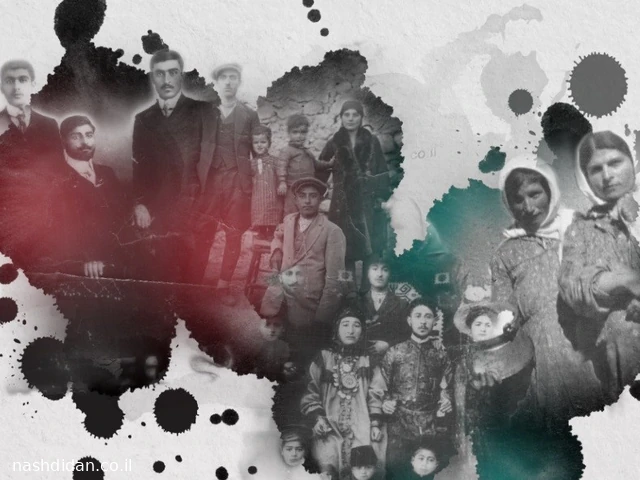
Our People
Nash Didan, meaning “our people” in Aramaic, is the name by which a Jewish community with ancient roots is known today. The community originated in the region of Urmia, Salmas, Başkale, and surrounding areas of northwestern Iran and eastern Anatolia.
For generations, members of the community lived in Urmia, Salmas, Başkale, and in other cities, towns, and villages throughout the region. Although families were often identified by their particular town or village, they shared deep family, religious, cultural, and historical connections. It was a mountainous area connecting Persia, Mesopotamia, Anatolia, and the Caucasus — a meeting place of peoples, languages, religions, and cultures.
Within this world, the Jews of the region maintained family and communal life, synagogues, and Jewish traditions. They engaged in trade and various crafts, and in some settlements also in agriculture and sheep raising. Family, commercial, and marriage ties connected the communities on both sides of what is today an international border.
One of the community’s most distinctive characteristics was Lishan Didan – “our language”: Jewish varieties of Northeastern Neo-Aramaic that served as the home and everyday language of many members of the community.
Alongside Aramaic, community members also spoke the languages of their surroundings — Azerbaijani, Turkish, Persian, and Kurdish — depending on where they lived and with whom they came into contact. Thus emerged a Jewish world deeply rooted in its own traditions while also being part of the multilingual and multicultural environment around it.
The Roots of an Ancient Community
The Jewish presence in the region is documented over many centuries.
Medieval sources already mention Urmia as a place where Jews lived, and a document associated with a Judeo-Arabic manuscript attests to the existence of a synagogue in Urmia about a thousand years ago.
In the 19th century, the documentation becomes more detailed. Travelers who visited the region described organized Jewish communities, synagogues, and hundreds of Jewish families in Urmia and Salmas. Additional accounts indicate a Jewish presence in the Başkale area and beyond the mountains as well.
Alongside the historical documentation, a longstanding tradition among members of the community connects the beginnings of Jewish settlement in the region to the Assyrian exile of the Kingdom of Israel in the eighth century BCE. This is an important ancestral tradition in the community’s identity. Existing research allows us to document with confidence a Jewish presence in the region for at least about a thousand years, while the more ancient beginnings of the community remain part of tradition and ongoing research. The documented history of these communities provides an important foundation for understanding the people who today identify with the broader heritage of Nash Didan.
Lishan Didan – Our Language
Language is one of the most distinctive treasures carried by the community.
The Aramaic of the Jews of Urmia and its surroundings was a living language. It was spoken at home, used to tell stories, argue, laugh, bless children, and pass memories from one generation to the next.
There was not one identical dialect throughout the region. Urmia, Salmas, and other communities had their own forms of speech, and over the generations the dialects absorbed words and influences from the languages around them.
In the 20th century, these dialects were documented in extensive linguistic research, including the work of Irene Garbell and Geoffrey Khan. Thanks to the documentation of native speakers, not only words and grammar were preserved, but also stories, expressions, customs, and memories of the world from which the language emerged.
After immigration to Israel, Hebrew became the principal language of the younger generations, and today Lishan Didan is a heritage language at risk of disappearing. For this reason, documenting the words, voices, and stories that remain is a central part of preserving the community’s heritage.
Life Between Urmia, Salmas, and Başkale
Community life existed within a world of family, work, faith, and tradition.
Jews engaged in trade in fabrics, jewelry, food, and dried fruit, as well as goldsmithing and money changing. In smaller settlements, some families also worked in agriculture, vineyards, and animal husbandry.
The harsh winters of the region shaped the way people lived. Families prepared in advance for months of snow and cold, stored food, and preserved produce. Children learned prayers, blessings, Torah, and Hebrew, and later general educational frameworks were also established.
Weddings, holidays, and family celebrations were important centers of communal life. Around them developed customs, music, foods, and ceremonies, some of which continued to live on even after immigration to Israel.
The cuisine of Nash Didan also tells the story of the region: a Jewish cuisine shaped through encounters with Persian, Azerbaijani, Turkish, and Kurdish cultures, while acquiring a distinctive character in each family and community.
A Community Within a World of Peoples and Cultures
For generations, the Jews of the Nash Didan communities lived alongside Azerbaijanis, Kurds, Assyrians, Armenians, and other groups.
Markets, work, trade, and neighborhood life created connections between the communities. People in the region often knew several languages and lived within a diverse cultural environment.
The history of the region also included difficult periods of instability, struggles for control, and violence. As a minority community, Jewish life was affected by local rulers and by changing relationships between the different groups living in the region.
World War I was a major turning point. The area between Urmia, Salmas, Van, and Hakkari became a theater of war, changes of rule, and displacement. Communities suffered, families moved, and the world that had existed in the region for generations began to change fundamentally.
From Urmia to Jerusalem
The connection to the Land of Israel existed even before the major waves of immigration, through rabbis, emissaries, and religious books.
From the late 19th century and throughout the 20th century, families from the community began making their way to the Land of Israel. At times, the journey was long and difficult, lasting months or even years and passing through different countries and continents.
After immigration, members of the community began rebuilding their lives in Israel. Many settled in Jerusalem, particularly in neighborhoods where groups of immigrants from Urmia and its surroundings established themselves. They built families, communal institutions, and synagogues that served not only as places of prayer but also as centers for maintaining community ties and preserving tradition.
Among the synagogues associated with the community in Jerusalem were Yavneh Synagogue and Shmuel HaNavi Synagogue for the Edat HaTargum. These synagogues provided places where the prayers, customs, and traditions brought by the immigrants from their homeland could continue to be heard and practiced.
Over the years, many families also moved to Holon, Tel Aviv, and other parts of Israel. The community thus became geographically dispersed, while continuing to maintain family and social connections and a shared sense of belonging.
The Emergence of the Name “Nash Didan”
It was precisely within the new reality of the State of Israel that the broader meaning of the expression Nash Didan gradually took shape.
In Israel, people who had come from Urmia, Salmas, Başkale, and different villages and settlements throughout the region met one another. In their homeland, many had primarily been identified by their place of residence — Urmia, Salmas, Başkale, or a particular village. In Israel, however, a new reality emerged in which people from different places within the same geographic region met and began building a shared life.
Within this reality, the Aramaic expression “Nash Didan” – “our people” acquired a broader meaning of belonging. Among immigrants and their descendants, it gradually became the name associated with the community as a whole.
A Heritage That Lives On Today
Today, most descendants of the community live far from the cities and villages where their ancestors lived.
But the heritage continues.
It lives in family names and old photographs, in recipes passed down through families, in melodies and customs, in Aramaic words still heard around the family table, in immigration stories, and in memories passed from parents to children and grandchildren.
For decades, efforts were made to preserve this heritage through community and cultural activities. Gatherings, cultural evenings, performances, and theatrical productions enabled members of the older generation to bring their language, stories, music, customs, and humor to the stage and to the wider public.
This cultural activity was much more than entertainment. It was a way of preserving memories and transmitting them from one generation to the next. For younger members of the community, these gatherings and performances provided an opportunity to hear the language, learn the stories, and experience part of the world from which their parents and grandparents had come.
Performances, gatherings, and theatrical productions organized by members of the community continued until only a few years ago and for a long period formed an important part of the cultural life of Nash Didan descendants. Through the stage and through community gatherings, stories, characters, songs, humor, customs, and memories continued to live on — things that might otherwise not have reached the next generation.
Today, the heritage continues in gatherings of community members and their descendants.
Groups still meet to maintain their connections, remember their families and places of origin, and above all, to speak Lishan Didan with one another.
For those who still speak the language, such a gathering is more than an act of linguistic preservation. When people sit together and converse in Lishan Didan, the language returns, even briefly, to its natural setting — among people, within a family and community, in everyday life.
In this way, Lishan Didan continues to exist not only in books, dictionaries, academic research, and recordings, but also in the voices of people who still use it and pass it on.
The heritage also lives in documents, diaries, and personal testimonies — including the diary of Sinior Demirel, which records from a personal perspective the life of the region during the turbulent period of the early twentieth century.
Each of these elements tells part of a larger story.
It is the story of a Jewish community that lived for generations in the region between Lake Urmia and Lake Van; that preserved its Jewish identity and language within a world of many cultures and languages; that experienced wars, displacement, and immigration; that built a new life, synagogues, and communal institutions in Israel; and whose members and descendants continue to carry its memory in Israel and throughout the world.
Nash Didan.
The Nash Didan Community Archive
Nash Didan is also a living community archive, created to preserve and make accessible the story of the community for future generations.
The archive brings together family photographs, historical documents, immigration stories, personal memories, recipes, customs, historical newspaper clippings, recordings, videos, and material documenting Lishan Didan and the cultural life of the community.
These materials come from families and community members and help connect individual memories with the broader history of Nash Didan. The archive continues to grow as additional photographs, documents, testimonies, and family stories are preserved and shared.
Preserving this material is not only a way of looking back. It is a way of ensuring that the people, places, language, customs, and experiences that shaped the community remain accessible to future generations.
Nash Didan.
Our People.
This page was edited on September 29th, 2026 so some of the comments could be irrelevant
The record stated above mentions that ” In 2005, about 14,000 of the Nash Didan lived in Israel. “… How about those (Nash Didan) unknown-population who could NOT migrate to Israel, and they remained in Kurdistan (Zaxo, Zagros-Mountains, Urmiye, Hewler, Kermansah, Amed, Shernax, Cîziré, Sason, Derîq…etc).
My Grandparents from both sides (Sino & Ida- Sabré & Musto had to hide their identities entire of their lives and had to pretend to “be” muslim for the outside world but yet in our household ” subconsciously” NOONE at home really care about any religion motives of the outside world , particicularly not avreligion which literally FORCED us to convert & accept their belief!
Even today, most of Kurdish households (who still “subconsciously” have strong Jewish traditions/attitudes, cultures etc) still do not really accept the islam nor recognise it, but yet, as we are entirely surrounded by “that world” geograhpically, and we Kurds do not have any official State, we still need to live by their rules…
Sometimes I almost hate my Grandparents about why they never moved to Israel in the 50s instead of staying & being FORCED to become Something they NEVER accepted nor LOVED!
Peace & Love may always shine on ISRAEL !
Aramaic was the international language in the region, many spoke it. The differences in the dialect teach us that there are many ethnic groups that speak aramaic, and it is not the same dialect, there are diferences.
Your tradition is yours, ours is ours. I speak of mine, but you insist that you will alter my history for your needs. You ignore academic research and bring links to a patriarch I have no interest to hear….
“Our people” The Nash-Didan is a Jewish term that came to be common by Jews in 1920’s In Israel only. It was in use by members of the Jewish communities originated in Urmia region and it reffers to the Jewish people who lived seperetly in those regions.
You can play with definitions as much as you like, but don’t drag us into your game. We are a part of the Jewish Israeli state, not Assyria we came from here and came back now. Again, that has nothing to do with you…
Thank you for your interest.
Rabban Breikah,
Thank you for these passages and your interest in historical accuracy. There is no need however for sarcasm or putting down other people who write and propose their own theories. .
Aramaic…Ashurit…Hebrew..- no matter your particular attachment, chag Purim sameach, may evil leaders and advisors be defeated, in those days and today too.
On one hand there is thousands of years of history, science an academic – historical, archiological research etc… On the other hand comes those Assyrians “theories” that claims that all *my* heritage is not true.
nope, thats not balanced and those “theories” are not welcomed here.
חג שמח
Michael
Thank you Joseph,
To Michael, you mention ancillary sources as if we are to merit their theories. First of all you are “Nash Didan”, meaning “our people”. Never in any Syriac or Hebrew literature will you find any self-determination of “Aramean” that hasn’t already been dismissed from tradition. You state tradition, yet both the Bavli and the Syriac sources attest to the same identity. What your family speaks is what my family speaks and it’s East Syriac, the dialect of which has survived as Modern Hebrew. The Urmia dialect of Nash Didan is in the East Syriac dialect. In fact, the West Syriac Church has an agreement that only “Suryoyo” is the official self-determination. Listen to the Patriarch of the Syriac Orthodox Church in his own words.
https://youtu.be/CMr485Nw1pg?t=135
Hi David,
My great grandfather, Mordechai (Michael) Abraham was founding member of the Iran Hebrew Congregation as well. I was wondering if you might have any records, we could cross reference. I’ve recently been trying to learn more about him.
I just noticed this post. I am not on Social Media whatsoever but you can reach out to me at dsmeyerson@gmail.com. I only have some old photos and cookbooks from Persian Hebrew (f/k/a Iran Hebrew Congregation)
Thanks! I will.
I really don’t like Assyrian extremists coming here and making all sorts of delusional arguments….
– Ashurit is not Hebrew
– Real academic research connects our language with ancient Aramaic. Look for NENA dialects online.
– My family, as many more – speak aramaic for thousands of years and there is not much you can say to contradict that now, here.
– You connect dots very oddly and obviously have an agenda to go with.
We are not interested in your comments, don’t bother.
Why are you lying? Even the Talmud states, in Megillah 18a:23, “§ It was taught in the mishna: And one who speaks a foreign language who heard the Megilla being read in Ashurit, i.e., in Hebrew, has fulfilled his obligation.”
Do you hear a script? What Aramaic?
Does not Megillah 18a:16 already state, “The Gemara asks: What are the circumstances of the case? If we say that the Megilla was written in Ashurit, i.e., in Hebrew…”?
Sanhedrin 21b:22 states, “§ Mar Zutra says, and some say that it is Mar Ukva who says: Initially, the Torah was given to the Jewish people in Ivrit script, the original form of the written language, and the sacred tongue, Hebrew. It was given to them again in the days of Ezra in Ashurit script and the Aramaic tongue. The Jewish people selected Ashurit script and the sacred tongue for the Torah scroll and left Ivrit script and the Aramaic tongue for the commoners.”
You can surely put two and two together? Megillah 18a:23 and Sanhedrin 21b:22 correlates Hebrew therewith Ashurit, i.e. the sacred tongue. What is this “we speak Aramaic”? Since when have Jews deviated from tradition?
Thanks for sharing David. Join us at out facebook group here –
https://www.facebook.com/groups/nashdidan/
Michael
My grandfather Izzachar Mechti (?) a/k/a Isadore Meyerson was from Urmia and he helped found the Persian Schul in the Chicago/Skokie area. His marriage was arranged with a Turkish Jew Victorya Ojalvo (Sephardic) and they settled in the Chicago area. My grandfather spoke Aramaic and was well known in the Chicago Persian Community.